· Workspace Trends · 6 min read
Bio-Intelligent Design: The 2026 Workspace for Indian Business Growth
The premium workspace has evolved into a strategic tool. Explore how Bio-Intelligent Design and neuro-inclusive principles are boosting productivity, reducing costs, and becoming essential for sustainable growth in 2026.
TL;DR: The workspace in 2026 is a strategic growth asset. For Indian businesses, adopting Bio-Intelligent Design principles—like neuro-inclusive layouts and adaptive environments—directly combats hybrid fatigue, boosts productivity by 15%, and offers significant financial flexibility. This evolution is critical for attracting talent and sustaining growth in a competitive market.
Introduction: Beyond the Four Walls
For the Indian entrepreneur or branch manager, the office is more than an address; it’s a crucial lever for talent, productivity, and scalability. The traditional five-year lease in a fixed building no longer aligns with dynamic business needs or the expectations of a modern workforce. Rising commercial rents in hubs like Chennai’s OMR, coupled with the need for operational agility, demand a smarter approach. The global trend, as noted in reports by GCUC, shows corporations now see flexible workspaces as core real estate, not a temporary fix. This shift is towards bio-intelligent design, where the environment is engineered to support human biology and cognitive diversity, turning real estate from a cost centre into a growth partner.
What is Bio-Intelligent Design?
Bio-intelligent design is an advanced workspace philosophy that integrates architectural elements with human biology and neuroscience. It moves beyond basic amenities to create environments that actively support metabolic health, circadian rhythms, and neuro-inclusivity. The goal is to mitigate workplace stressors like ‘hybrid fatigue’ by designing spaces that adapt to physiological and cognitive needs, thereby enhancing well-being and sustainable productivity.
The Business Case: Productivity, People, and P&L
Adopting a bio-intelligent workspace isn’t a luxury; it’s a strategic investment with measurable returns. For an Indian SME, the primary metrics are productivity, talent retention, and cost management. Strategic ergonomic and sensory interventions are now linked to a 67% reduction in absenteeism and a 15% increase in baseline productivity. This isn’t abstract—it translates directly to project velocity and output quality. Furthermore, with 1 in 7 professionals identifying as neurodivergent, a neuro-inclusive environment is key to unlocking the full potential of your team and attracting top talent who value thoughtful employers.
Manager Insight: “In our experience, providing a range of dedicated work zones—from deep-focus pods to collaborative studios—has been the single biggest factor in improving team satisfaction and project delivery times.”
Consider the financial flexibility. Traditional commercial leases in India have shortened, but a 5-7 year commitment still ties up capital. A premium flexible workspace converts a large, fixed capital expenditure (capex) into a predictable operational expense (opex), freeing up funds for core business activities like R&D or marketing.
| Cost Factor | Traditional Office (Chennai, Prime Location) | Bio-Intelligent Flexible Workspace |
|---|---|---|
| Upfront Capex | ₹15-25 Lakhs (furniture, IT, fit-out) | Typically ₹0 (Furniture-as-a-Service model) |
| Monthly Commitment | Fixed rent + maintenance (~₹2-4 Lakhs) | Scalable membership fees |
| Contract Flexibility | 60-84 months (5-7 years) | Month-to-month or annual terms |
| Operational Overheads | Management, utilities, AMC contracts | Often bundled into a single invoice |
Is Your Workspace Designed for India’s Neurodiverse Talent?
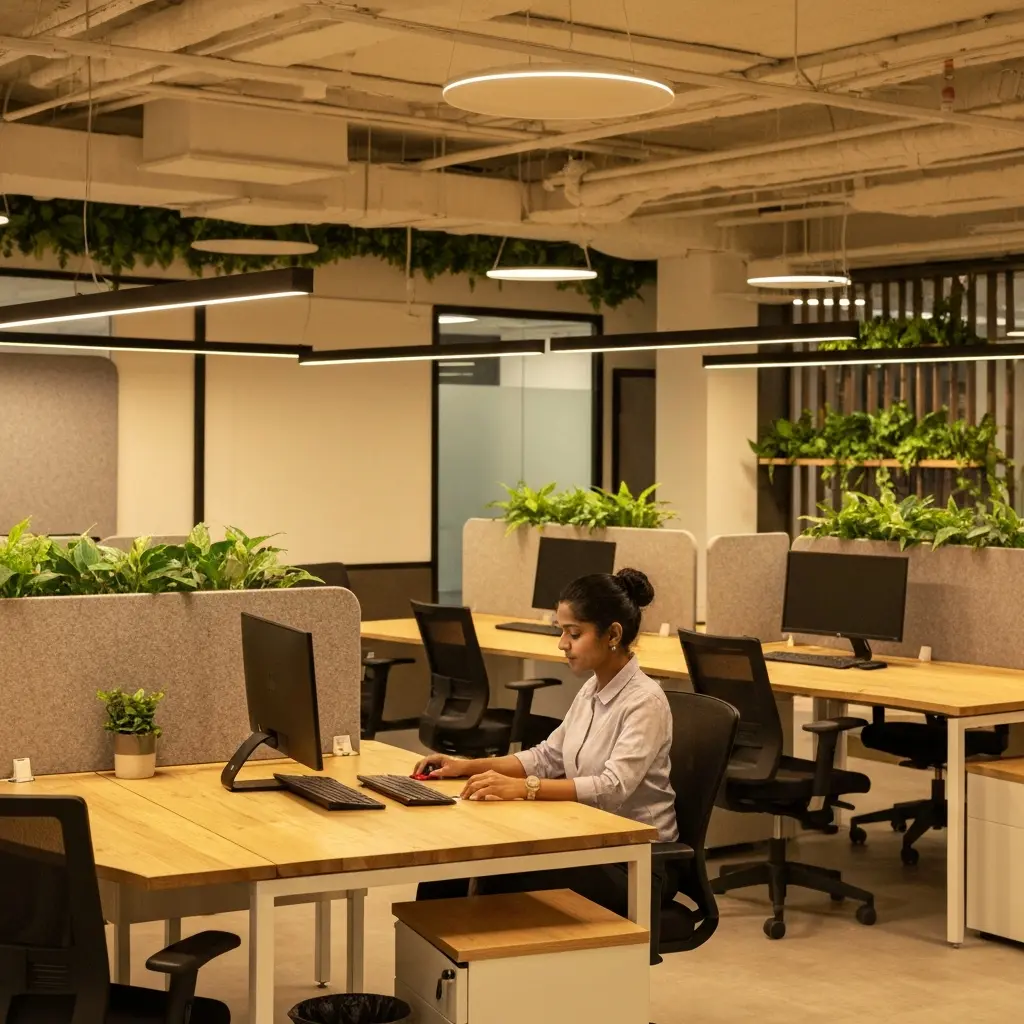
The ‘one-size-fits-all’ open plan is obsolete. The 2026 standard is ‘Sensory Zoning,’ guided by the ‘6 Cs’ model: Concentrate, Contemplate, Commune, Create, Congregate, and Convivial. This means having sound-proof hush-pods for calls that can’t be interrupted by Chennai’s street noise, contemplate zones with softer lighting for strategic thinking, and vibrant commune areas for spontaneous collaboration. This structure respects individual work styles—a critical factor in reducing the cognitive load of hybrid schedules where focus time is precious.
Acoustic privacy remains the top complaint. Modern solutions include acoustic micro-zoning using materials like felt and wood, and modular pods that can be reconfigured as team needs change. This directly addresses the unpredictable noise of a partially occupied hybrid office, ensuring that a video conference isn’t disrupted by a lively discussion nearby.
[Image of a Sensory Zoning Floor Plan] A diagram showing a workspace floorplan segmented into the ‘6 Cs’ zones: Concentrate (quiet pods), Contemplate (soft seating), Commune (high-top tables), Create (writeable walls), Congregate (larger meeting area), Convivial (café-style lounge).
How Do Circular Economics and Adaptive Tech Future-Proof Your Office?
Sustainability in 2026 is circular and integrated into operations. Leading operators are adopting Circular Furniture Systems and Furniture-as-a-Service (FaaS). For an Indian business, this means you are not stuck with outdated furniture after a growth spurt or pivot; you can refresh your space without waste or significant cost, aligning with evolving ESG (Environmental, Social, and Governance) reporting expectations.
Biophilic Design 2.0 is also critical in the Indian context. It’s no longer just about plants. Adaptive Lighting systems that sync with indoor HVAC to mimic the local outdoor light cycle are essential. In Chennai’s humid climate, a system that balances light temperature and cooling can help regulate circadian rhythms, combating the afternoon energy slump and supporting overall metabolic health—a direct boost to daily output and long-term well-being.
Business Growth Tip: When evaluating a workspace, ask about their sustainability and tech stack. A provider invested in circular systems and adaptive biophilia is investing in your team’s long-term performance, not just providing desks.
The 2026 Outlook for India’s Workspace Market
The Indian flexible workspace market will continue its rapid maturation. We anticipate a sharper bifurcation: generic, cost-driven spaces will struggle, while premium, specialist environments will command a premium. Niche spaces for sectors like MedTech, FinTech, and creative industries will grow, as seen in the global trend where specialised spaces outperform generalists. For Chennai, locations with superior multi-modal connectivity (Metro, major roads) and integrated wellness amenities will see occupancy rates stabilise well above 70%. The workspace will be judged not on ‘Instagrammability,’ but on its tangible contribution to business health and employee vitality.
Key Takeaways for Business Leaders
- Productivity is Engineered: A scientifically designed workspace can increase baseline productivity by ~15% and drastically reduce absenteeism.
- Neuro-inclusivity is Non-Negotiable: Implementing Sensory Zoning (the 6 Cs) is essential to support a diverse, modern workforce and unlock full team potential.
- Financial Agility Wins: Flexible terms convert large real estate capex into manageable opex, protecting cash flow for strategic investments.
- Demand Specialisation: Consider niche or sector-focused workspaces that foster deeper networking and collaboration within your industry.
- Sustainability is Operational: Choose partners with circular furniture models and adaptive biophilic systems to future-proof your space and align with ESG goals.
Conclusion
The workspace of 2026 is a dynamic, responsive partner in your business growth. It is no longer a passive container but an active platform designed to enhance human performance, foster inclusion, and provide unparalleled strategic flexibility. For founders and managers in India, adopting this next-generation approach is a decisive step towards sustainable scaling and talent leadership.
We invite you to experience this evolution at Crizone Business Centre, where our spaces are designed with these very principles in mind, providing Chennai’s businesses with a calmly efficient environment to focus on what matters most: growth.