· Business Growth & Workspace · 6 min read
The Great Compliance 2026: Why Magnet Offices Are Key to Growth
The Great Compliance of 2026 signals a return to the office. Discover how high-performance 'Magnet' workspaces drive Indian business growth by attracting talent and boosting productivity.

TL;DR: The Great Compliance 2026 marks a pivot back to the office, but not as we knew it. Success now depends on creating ‘Magnet’ workspaces that justify the commute with superior design, dynamic infrastructure, and curated experiences, directly impacting talent attraction and operational efficiency for Indian businesses.
Introduction
For Indian entrepreneurs and growing SMEs, the perennial challenge has been balancing growth with cost. Traditional office leases in Chennai’s prime locales like OMR or Guindy demand significant capital outlay, multi-year commitments, and the headache of managing utilities, maintenance, and compliance. Yet, in 2026, the equation has shifted. The The Great Compliance 2026 is underway, with worker resistance to office mandates falling sharply. The demand is no longer for mere desks, but for workspaces that actively enhance business performance. This shift moves the conversation from simple cost-saving to strategic investment in a high-performance environment that attracts top talent and fosters productivity, a critical pivot for any business aiming to scale in today’s competitive landscape.
What is The Great Compliance 2026?
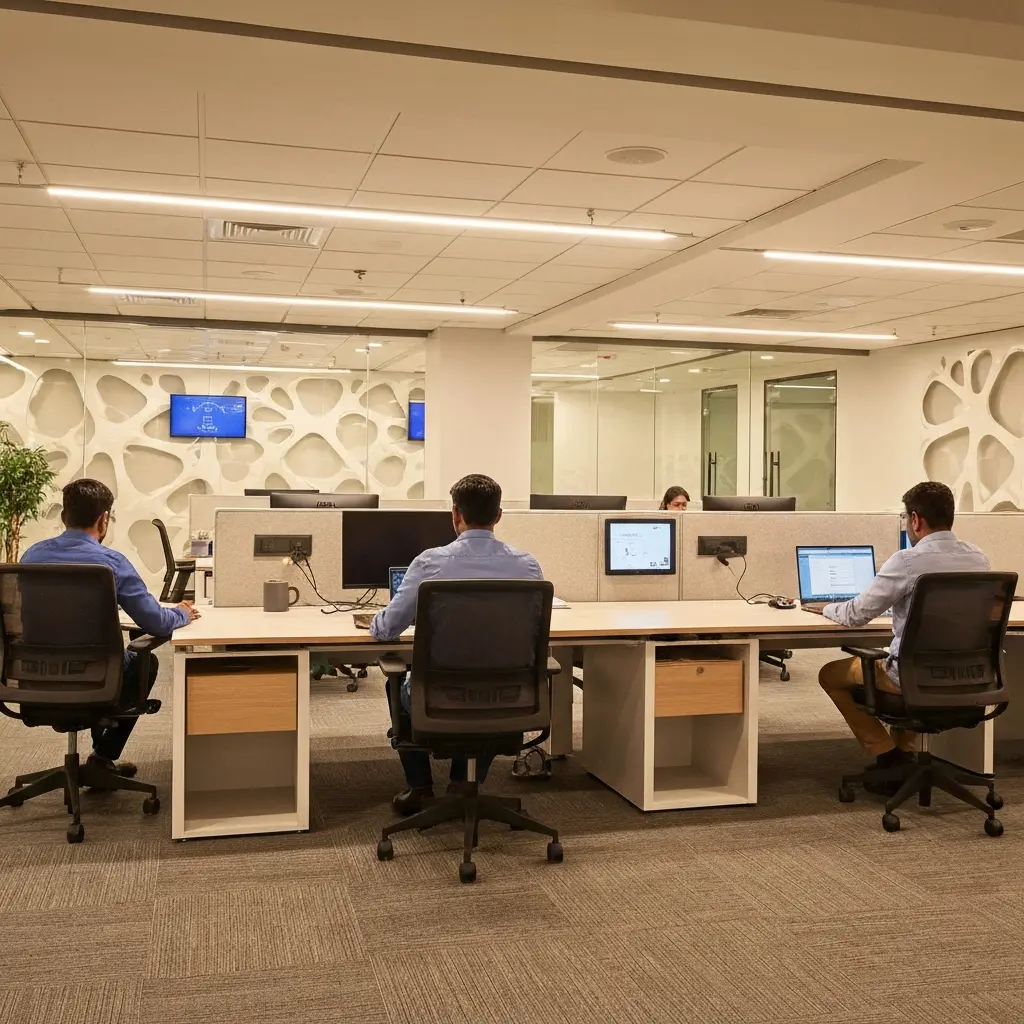
The Great Compliance 2026 refers to the significant decline in employee pushback against mandatory Return-to-Office (RTO) policies, contrasting sharply with the earlier ‘Great Resignation’ era. By early 2026, only 7% of employees indicated they would quit over an RTO mandate, down from 51% in 2025. This compliance, however, is conditional. Employees now expect their workplace to offer compelling value—termed ‘Commute-Worthiness’—justifying the time and cost of travel. This has forced operators and companies to evolve from providing basic space to creating curated, high-performance ‘Magnet Offices’ designed to enhance focus, collaboration, and overall work experience.
The New Productivity Calculus: From Occupancy to Utility
Global office occupancy has stabilised at a ‘New Normal’, peaking at 59% on Tuesdays. This creates a pronounced ‘mid-week crunch’ that strains traditional, fixed-cost office models. For an Indian SME, this inefficiency is costly: paying for a full-time lease while space sits underutilised. Simultaneously, how we use space has changed dramatically. A staggering 80% of in-office meetings now involve six people or fewer, yet traditional large boardrooms remain 88% empty. This mismatch represents wasted capital and lost opportunity.
The solution lies in dynamic, activity-based design. The demand has shifted from open-plan floors to ‘Semi-Private’ zones. Utilization of distraction-free booths and quiet pods has surged by 22% year-on-year as professionals seek ‘focus-as-a-service’. For a founder, this means your team’s in-office days are maximised for deep work and effective collaboration, not distraction. It turns real estate from a fixed cost into a variable tool for productivity.
Crizone Pro Tip: Audit your team’s weekly rhythms. Are Tuesdays and Wednesdays for collaboration, and Thursdays for focused work? Choose a workspace that offers both vibrant breakout areas for team huddles and sound-proof pods for uninterrupted strategy sessions, ensuring every commute is justified by output.
The Strategic Lever: Cost, Flexibility, and Talent
Financially, the argument for flexible, high-performance workspace is compelling for Indian businesses. Contrast the capital expenditure and rigid commitment of a traditional lease with the operational expenditure model of a premium flexible workspace. The latter converts fixed costs into variable, scalable ones, freeing up crucial capital for core business investment like R&D or marketing.
| Cost Factor | Traditional Chennai Office (OMR/GST Road, 10-seater) | Premium Flexible Workspace Solution |
|---|---|---|
| Monthly Base Rent | ₹ 2.5 - 3.5 Lakhs + GST | From ₹ 75,000 for dedicated desks |
| Security Deposit | 10-12 Months Rent (₹ 25-40 Lakhs) | Typically 1-2 Months Fee |
| Lock-in Period | 3-5 Years | Monthly or Annual, with scalability |
| Fit-out & Furniture | ₹ 8-15 Lakhs (Capex) | Included (Operational Cost) |
| Maintenance & AMC | ₹ 20,000 - 40,000/month | Included |
| Administrative Overhead | High (Facility Manager, IT support) | Managed by operator |
This financial agility is matched by a strategic talent advantage. With 65% of employees now valuing location flexibility and workplace experience over raw salary increases, your office becomes a recruitment and retention tool. A ‘Magnet Office’ with premium amenities, reliable high-speed internet (a non-negotiable in India), and a professional address can be the deciding factor for top talent choosing between your startup and a corporate giant. As per JLL’s ‘Future of Work’ report, enterprises are integrating flex space to create portfolio elasticity, hedging against volatile headcounts—a strategy now accessible to SMEs.
Is Your Workspace Strategy Ready for 2027?
The trends point to further consolidation of this new model. By the end of 2027, 73% of major corporate occupiers aim for a desk-sharing ratio of at least 1.5:1. The revenue models for workspace providers are already evolving, with 54% moving to ‘Activity-Based’ billing for high-demand amenities like advanced video-conferencing rooms. For a business leader, the question is whether your workspace can adapt.
A static, long-lease office cannot easily adjust to these ratios or new billing models. It locks you into a fixed pattern. A strategic partnership with a flexible workspace provider, however, allows you to right-size in real-time, pay only for the collaboration rooms you use on peak days, and avoid the sunk cost of empty boardrooms. It provides the institutional-grade ‘elastic portfolio’ strategy at a fraction of the complexity and cost.
Manager Insight: “The festive season or project-based downtime no longer means paying for empty chairs. We scale our team’s access up or down based on deliverables, keeping our overheads tightly aligned with revenue cycles—a critical efficiency for Indian businesses.”
The 2026 Outlook for Indian Workspaces
In 2026, the Indian workspace market will see a clear bifurcation. Basic, commoditised coworking will struggle, while demand will surge for premium, curated environments that function as talent magnets and productivity engines. Location will be redefined by multimodal connectivity—proximity to Metro stations will be as valuable as the address itself, helping professionals skip the notorious OMR or Cathedral Road traffic. We will also see a rise in ‘hub-and-spoke’ models, where enterprises use a central magnet office alongside smaller flexible spokes, a strategy perfectly suited for a city like Chennai with its growing peripheral business districts. The workspace will be judged not on square footage, but on its contribution to business outcomes.
Key Takeaways
- Commute-Worthiness is Key: Your office must actively justify the travel time with superior infrastructure, design, and experience to attract and retain talent.
- Adopt Activity-Based Design: Move beyond open floors. Prioritise spaces that support both focused work (quiet pods) and small-group collaboration (huddle rooms).
- Convert Capex to Opex: Shift from large capital leases to flexible operational memberships to free up cash flow for core business growth.
- Plan for Elasticity: Choose a workspace solution that allows you to scale seats and services up or down aligned with project cycles and headcount volatility.
- Leverage Managed Services: Offload non-core administrative burdens like IT, maintenance, and GST-compliant billing to focus entirely on your business.
Conclusion
The The Great Compliance 2026 is not a simple return to the past. It is a strategic evolution towards workplaces that are worth returning to. For the ambitious Indian entrepreneur, freelancer, or branch manager, this shift presents an opportunity to leverage real estate as a dynamic tool for growth, talent attraction, and operational resilience. The right workspace is no longer an overhead; it is a growth partner. Discover how a curated, high-performance environment at Crizone Business Centre can become the magnet for your next phase of growth in Chennai.
Continue your workspace search
Explore the most relevant Crizone pages next
If this article is part of your Chennai workspace research, these pages help you move from reading into comparing live plans, locations, and fit.
Explore coworking plans in Chennai
Compare day passes, dedicated desks, private offices, meeting rooms, and virtual office options from one commercial hub page.
Book a day pass in Chennai
Best fit if you need occasional workspace access, a short productive break from home, or a flexible desk for a single day.
Compare dedicated desk options
A stronger fit for regular monthly use when you want a fixed seat, better routine, and predictable workspace costs.