· Workspace Trends · 6 min read
The Managed Office Hegemony: De-risking Enterprise Strategy in 2026
In 2026, Indian businesses are abandoning long-term leases for managed office spaces to gain real estate agility, cut costs, and boost productivity in a hybrid world.
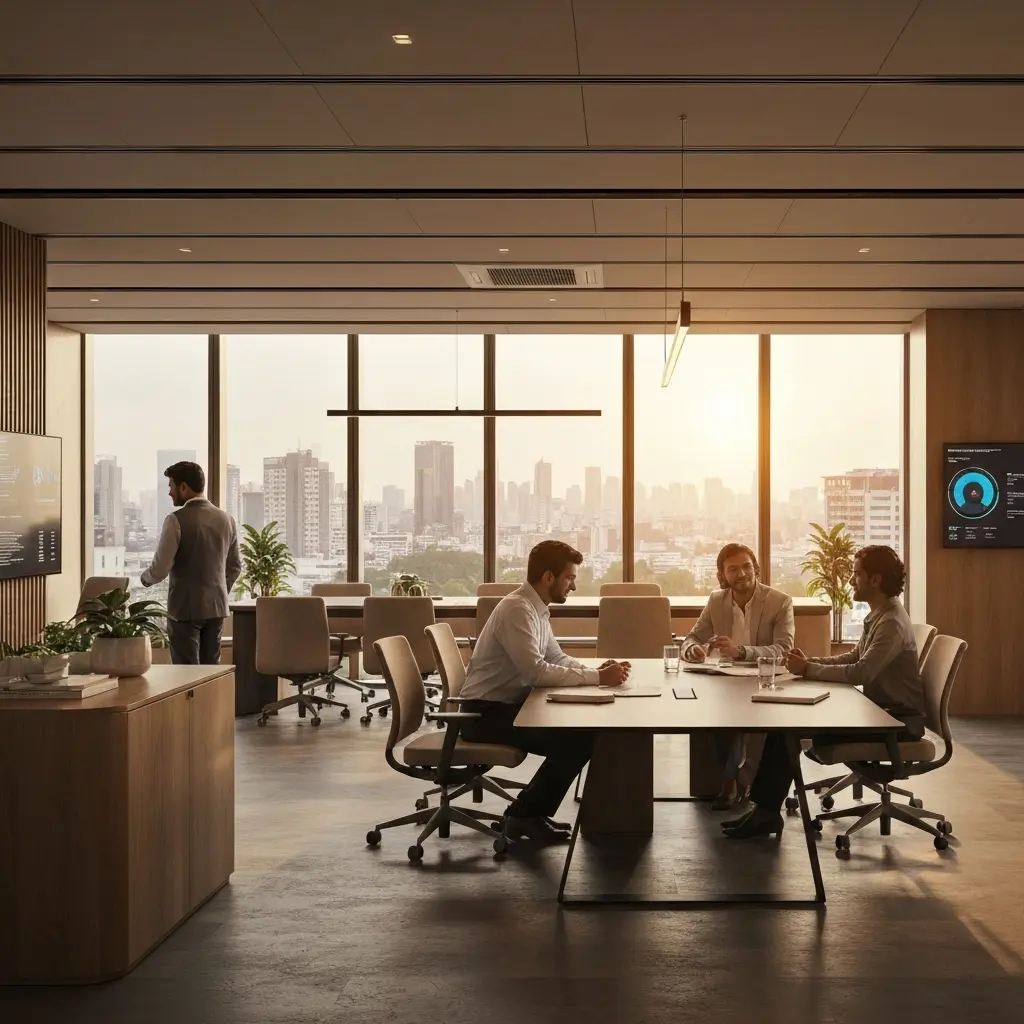
TL;DR: By 2026, managed offices are the new normal for corporate real estate. Indian businesses are shifting from rigid leases to flexible, 3-5-year agreements to de-risk portfolios, comply with RTO mandates, and unlock significant operational and financial agility in a volatile economy.
For the Indian business leader, navigating real estate has long been a high-stakes gamble. A 10-year lease in a prime location like Chennai’s OMR or Nungambakkam represents a colossal capital commitment and a fixed cost that can cripple agility. This traditional model is now giving way to a strategic evolution. The post-pandemic era, culminating in the stringent Return-to-Office (RTO) mandates of 2026, has rendered old models obsolete. Forward-thinking enterprises are pivoting their corporate real estate strategy to prioritise flexibility as their core enterprise flex strategy, transforming their office from a fixed asset into a dynamic growth lever.
What is Enterprise Flex Strategy?
An enterprise flex strategy is a corporate real estate approach that strategically replaces or supplements traditional long-term leases with managed, flexible workspace solutions. It treats physical space as an agile, operational expense (OpEx) rather than a rigid capital expense (CapEx), allowing companies to scale teams up or down, access premium locations without long-term liability, and rapidly deploy hybrid work models. For Indian businesses, this means gaining enterprise-grade infrastructure with the agility of a startup.
The Financial Imperative: From CapEx Anchor to OpEx Advantage
The primary driver for this shift is a fundamental re-evaluation of cost and risk. A traditional office lease in Chennai, requiring hefty security deposits, fit-out costs, and long-term maintenance, locks capital that could fuel business growth. In contrast, a managed office converts this into a predictable monthly operational cost. As per JLL’s 2026 India Real Estate Outlook, corporate lease terms have shortened dramatically, reflecting a demand for agility. For an SME, this financial de-risking is transformative.
Consider the stark financial contrast for a 30-person team setting up in a Chennai business district:
| Cost Factor | Traditional Office Lease | Managed Office Solution (e.g., Crizone) |
|---|---|---|
| Security Deposit | ₹10-15 Lakhs (refundable after years) | Typically 2-3 months of membership fee |
| Fit-out & Furniture | ₹20-30 Lakhs (one-time CapEx) | Included (Premium, ready-to-use) |
| Maintenance & AMC | ₹2-4 Lakhs/year (variable, separate) | Included (Predictable monthly cost) |
| Lock-in Period | 36-60 months (high exit penalty) | 12-36 months (flexible scaling options) |
| Administrative Overhead | Dedicated HR/Admin for vendor management | Managed by provider (single point of contact) |
Business Growth Tip: Calculate your Total Cost of Occupancy (TCO) over 3 years. Include fit-out depreciation, staff to manage facilities, and the opportunity cost of locked capital. The managed model often reveals 20-30% operational savings, freeing cash flow for core business investments.
[Image of a financial dashboard comparing Traditional Office TCO vs. Managed Office TCO over a 3-year period, with bars showing capital expenditure, operational expenses, and opportunity cost.]
Is Hub-and-Spoke the Answer to India’s RTO Mandate?
With 70% of companies enforcing formal 3-day-a-week RTO mandates in 2026, the ‘one central office’ model fails. Employees in areas like Anna Nagar or Pallavaram face draining commutes, hurting morale and productivity. The solution is the ‘hub-and-spoke’ model, powered by managed offices. A corporate HQ (the hub) is complemented by several smaller, professionally managed satellite offices (spokes) in suburban or secondary markets.
This aligns perfectly with the growing demand for the ‘15-minute city’ professional radius. A managed office in a location like Crizone’s strategically placed centres allows employees to work in a premium environment close to home, skipping grueling OMR traffic. Data shows a 25% YoY growth in demand for such suburban hubs. For the business, it becomes a powerful talent retention and recruitment tool, offering employees flexibility without sacrificing a professional workspace.
The 2026 Workspace: Beyond Desks to Performance Ecosystems
Merely providing desks is no longer sufficient. The 2026 workspace is a curated ecosystem designed to boost performance. Global trends show an 86% productivity boost for employees in flexible environments versus 65% in legacy offices. This gap is driven by three 2026 baselines: hospitality-grade service, mandatory sustainability, and hyper-specialisation.
Indian corporate tenants now expect premium wellness amenities, high-end community management, and spaces that foster collaboration. Sustainability is a procurement requirement, with 72% of enterprises demanding Green Building certifications—a checkmark that premium providers like Crizone prioritise. Furthermore, the market is seeing ‘Hyper-Specialisation,’ with spaces designed for specific sectors. This allows a MedTech startup to access lab-ready facilities or a fintech firm to be in a hub with relevant peers and potential clients, turning the office into a growth network.
Manager Insight: “Real-time occupancy analytics are the new ROI metric. IoT sensors help us optimise space usage dynamically, ensuring every square foot contributes to collaboration or focused work, maximising your investment.” – A Crizone Space Manager.
The 2026 Outlook for the Indian Market
The Indian flexible workspace market will accelerate its integration into core corporate strategy. We predict a surge in 3-to-5-year ‘enterprise managed agreements’ as the standard for new corporate setups, especially for branch offices in cities like Chennai, Bengaluru, and Hyderabad. Secondary markets (beyond traditional CBDs) will see premium flex space developments to capture the hub-and-spoke demand. Operators who fail to offer data-driven space utilisation insights, net-zero aligned infrastructure, and sector-specific community programming will fall behind. For Indian businesses, this means more choice, better technology, and workspaces that are genuine partners in growth.
Key Takeaways
- De-risk Financially: Shift from high-CapEx leases to predictable OpEx models, freeing capital for core business growth.
- Adopt Hub-and-Spoke: Use managed satellite offices to comply with RTO mandates while improving employee well-being and retention.
- Demand Data & Sustainability: Choose providers offering real-time space analytics and verifiable Green Building certifications.
- Prioritise Productivity Ecosystems: Select spaces designed for collaboration, wellness, and focus, not just occupancy.
- Think Strategic, Not Just Spatial: Your workspace should be a partner in talent strategy and business agility, not just a real estate transaction.
Conclusion
The hegemony of the managed office is not a fleeting trend but a fundamental restructuring of corporate real estate. For the Indian entrepreneur or branch manager, it presents an unparalleled opportunity to build resilience, attract talent, and fuel growth without the anchor of a long-term lease. It is the strategic answer to economic volatility, stringent RTO policies, and the relentless pursuit of efficiency. This exact, forward-thinking solution is what we provide at Crizone Business Centre, offering Chennai’s businesses a calibrated, premium, and growth-oriented environment designed for the realities of 2026 and beyond.