· Business Growth & Workspace · 9 min read
Fractal Design & Haptic Ergonomics: 2026’s Workspace Strategy
Explore how sensory-responsive workspaces with fractal architecture and haptic ergonomics are reducing stress by 60% and redefining the commute-worthy office for Indian businesses in 2026.
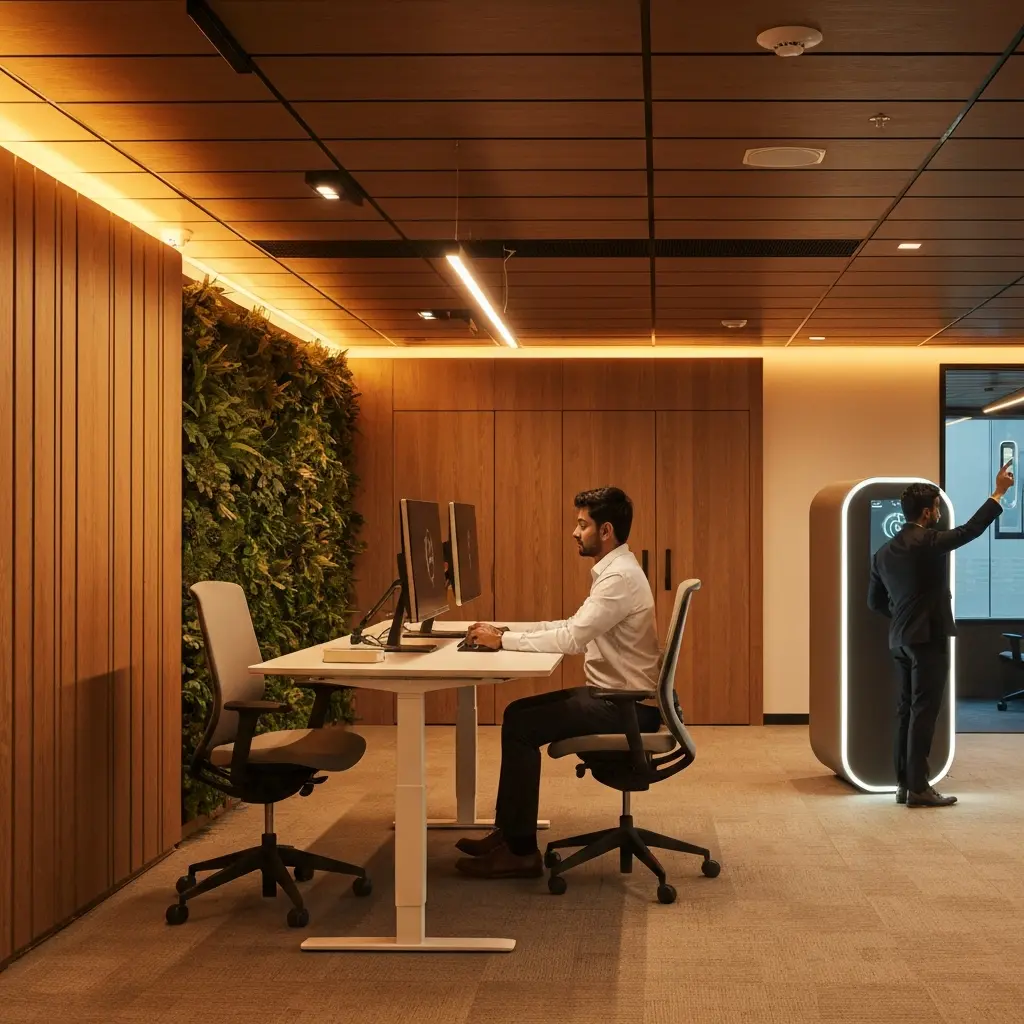
TL;DR: The 2026 office isn’t just a place; it’s a sensory reset. Fractal architecture reduces stress by 60%, while haptic ergonomics and circular materials combat hybrid fatigue. For Indian businesses, this shift from sterile desks to wellness-driven, commute-worthy spaces is the key to unlocking a 20% boost in focus-based productivity.\n\nThe conversation around Indian commercial real estate has fundamentally shifted. For years, a Grade A office on OMR or in Guindy was a trophy asset—a fixed cost to be minimised rather than a tool for growth. Now, with a 53% global office utilisation rate marking the peak of post-pandemic adjustment, the ‘why’ behind a commute has never been more critical. Simply leasing a white box filled with standard-issue cubicles no longer justifies an employee’s two-hour journey through Chennai traffic or the operational overhead a bootstrapped SME pays in TDS and rigid CAM charges.\n\nThe 2026 imperative is clear: the workspace must outperform the home office on every physiological and psychological metric. This is where the strategic deployment of sensory-responsive design—specifically Fractal Design and haptic ergonomics—enters the boardroom agenda. We are moving beyond basic aesthetics to a scientifically grounded approach that treats the physical environment as a biological reset button. For forward-thinking founders and branch managers, integrating these elements isn’t a soft perk; it’s a hard metric for cognitive performance and talent retention in a competitive Indian market.\n\n## What is Sensory-Responsive Workspace Design?\nSensory-responsive workspace design is an architectural and interior methodology that actively engages human senses—sight, touch, and sound—to reduce biological stress markers and enhance cognitive function. Rather than being visually neutral, these spaces use specific geometric patterns (fractals), tactile materials (haptics), and adaptive lighting (chronobiology) to trigger neurological calmness. The goal is to create an environment that subconsciously signals safety and focus, countering the ‘hybrid fatigue’ caused by digital overload and soulless residential work corners. This strategy is backed by research from the Smithsonian and CBRE, proving that our physical surroundings are a direct input into business output.\n\n### The 60% Stress Reset: Why Fractals Work\nThe most impactful shift in 2026 interior architecture is the adoption of fractal geometry. Unlike the sharp, hard lines of modernism that demand high cognitive processing energy, fractals are complex patterns that repeat at different scales—exactly like a fern leaf, a coastline, or a neural network. When integrated into architectural finishes and textiles, these patterns have been proven to reduce occupant stress levels by up to 60%. For a fund manager in T. Nagar or a creative lead in a startup, this isn’t about decoration; it’s a biological ‘visual diet’ that allows the prefrontal cortex to rest while the brain remains engaged.\n\n> Crizone Growth Tip: Indian knowledge workers often face high-pressure deadlines and sensory assault from dense urban commutes. An office that provides immediate visual calm upon entry acts as a silent anchor, drastically reducing the cortisol spike that typically derails the first hour of productivity.\n\n### The Rise of ‘Warm Minimalism’ and Haptic Ergonomics\nParallel to visual calm is the rise of touch. The 2026 furniture market has decisively rejected cold chrome and synthetic plastics in favour of ‘Warm Minimalism.’ We are seeing a surge in demand for unlacquered brass, which ages gracefully with a unique patina, and clay-based materials like raw terracotta. These materials offer a grounding, tactile experience simply absent from the mass-produced MDF desks of a typical home-office setup. Haptic ergonomics argues that touch isn’t just about comfort; it’s about emotional grounding. When your fingertips graze a sculptural cork wall or a raw silk upholstered panel, it signals a level of craft and permanence that stabilizes a transient hybrid workforce.\n\n[Image of Tactile sculptural cork wall with unlacquered brass and terracotta accents in a modern Indian office]\n\n### Acoustic Haptics: Sculpting the Sound of Silence\nA quiet office is an outdated concept. The 2026 goal is a sonically comfortable office, achieved through ‘Acoustic Haptics.’ This trend leverages carbon-negative materials like sculptural carved cork and stabilized moss canvases that serve a dual purpose. They are not only high-end tactile art pieces but also critical sound-absorbing infrastructure. In a busy coworking floor, these materials swallow the chaotic mid-frequencies of chatter without creating the sterile, pressurized silence of a sound-proof booth. The result is a ‘Coziness Index’ that rivals a premium hotel lobby, making the space feel emotionally safer than a traditional glass-and-steel corporate headquarters.\n\n| Sensory Element | Traditional Office (2023) | Sensory-Responsive Office (2026) |\n| :--- | :--- | :--- |\n| Visual | Monotonous gypsum ceilings, harsh grid lines | Fractal timber panelling, organic sightlines |\n| Touch | Melamine desks, nylon carpet tiles | Unlacquered brass edges, raw terracotta planters |\n| Acoustic | Fabric cubicle panels | Sculptural carved cork walls, moss art installations |\n| Cost Impact | Lower initial CAPEX, higher turnover stress | Strategic investment, quantifiable 20% productivity lift |\n\n### Is Chronobiology Lighting the End of the 3 PM Slump?\nLighting has evolved from simple visibility to a precise metabolic tool known as ‘Chronobiology Design.’ In the Indian context, where reliance on harsh white tube lights is common, this is a significant upgrade. Adaptive systems in 2026 sync Kelvin temperatures with human circadian rhythms: cool, high-intensity blue-enriched light for morning focus, transitioning to warm, amber tones in the late afternoon to facilitate natural recovery without drowsiness. This isn’t just ambient mood setting; it’s a direct countermeasure to the post-lunch dip in alertness that costs businesses crores in lost concentration. This technology, once reserved for elite medical facilities, is now a standard expectation in a commute-worthy office.\n\n## Circular Economy: Furniture as an ‘Operating Layer’\nFor Indian SME founders conscious of both the bottom line and ESG mandates, the 2026 procurement standard is audited circularity. 68% of B2B furniture buyers now willingly pay a premium for pieces designed for 100% disassembly. This means furniture is no longer viewed as static, depreciating infrastructure but as an ‘operating layer.’ Modular ecosystems allow a branch manager to reconfigure an entire zone in real-time based on live occupancy heatmaps, without generating a single kilo of waste. A team huddle in the morning can seamlessly morph into a quiet focus zone in the afternoon. This agility ensures that every square foot—billed at premium rates in cities like Chennai—is always generating active value, not just storing unused chairs.\n\n> Manager Insight: Don’t just look at the price tag. An audit-ready, disassemblable chair might cost 15% more upfront but holds residual material value and allows you to restructure your layout as team sizes fluctuate without expensive renovation downtime.\n\n### Beyond Nap Rooms: The NSDR Cognitive Reset\nThe concept of rest at work is being scientifically redefined. The 2026 premium workspace has moved past the awkward ‘nap pod’ into the realm of ‘Non-Sleep Deep Rest’ (NSDR). These aren’t places to sleep, but environments engineered for conscious recovery. NSDR pods utilize zero-gravity positioning to decompress the spine and localized acoustic damping to isolate the user. A 20-minute session in an NSDR pod can restore cognitive function and fluid intelligence as effectively as a 90-minute nap, without the grogginess. For a freelancer or a founder pulling a double shift before a client pitch, this is the ultimate biological hack for sustained high performance.\n\n## Atmospheric Vitality: The Functional Green Wall\nLiving walls have transitioned from decorative ‘plant-on-a-wall’ afterthoughts to sophisticated ‘Atmospheric Vitality’ systems. In 2026, these installations are engineered to functionally regulate humidity and indoor air quality (IAQ) to meet stringent wellness certifications like the latest WELL standards. This is acutely relevant in Chennai’s humid climate, where managing internal moisture load and air purity is a constant HVAC battle. A properly designed vitality wall doesn’t just look serene; it actively filters VOCs and stabilizes the microclimate, directly contributing to the 20% boost in focus-based productivity observed in data-driven design insights, compared to standardised open-plan layouts.\n\n[Image of A high-tech ‘Atmospheric Vitality’ living wall regulating air quality in a busy Indian coworking lounge]\n\n## The 2026 Outlook for Indian Workspaces\nLooking ahead, the ‘Coziness Index’ will become a negotiation point in commercial lease agreements. The resimercial trend—the merging of residential softness with commercial durability—will see an explosion of soft-touch organic fabrics on work chairs and lounge seating. Indian operators will move toward biophilic benchmarks, integrating multi-sensory elements as a standard to secure premium occupancies. We predict that Grade A buildings in Chennai that fail to adopt fractal and haptic strategies will start to see a valuation gap, as data from CBRE already indicates that talent retention is intrinsically linked to these physical wellness metrics. The office is no longer a container for people; it’s a tool for their collective vitality.\n\n## Key Takeaways\n- Audit your current workspace for sensory deprivation; replacing harsh lighting with chronobiology systems can immediately impact team energy levels.\n- Invest in haptic materials like unlacquered brass or cork, which signal permanence and quality, increasing the perceived value of your brand to clients.\n- Adopt a circular procurement policy to ensure your office layout can adapt to team changes without costly, wasteful renovation.\n- Prioritise acoustic haptics over silent rooms to create an environment that feels safely collaborative rather than rigidly quiet.\n- Trial NSDR or zero-gravity rest protocols as a high-performance alternative to traditional coffee breaks for cognitive reset.\n\nAs the line between living and working blurs, the Indian entrepreneur faces a clear choice: persist with a legacy lease that feels like a liability, or transition to a workspace that actively builds biological resilience. The sensory-responsive office, powered by fractal design and haptic ergonomics, is the definitive answer to hybrid fatigue. It’s a strategic upgrade that moves the dial on talent retention and daily output.\n\nAt Crizone Business Centre, we believe your workspace should be a growth partner, not just an expense. Our centres in Chennai are designed with the 2026 mindset, offering curated, commute-worthy environments that integrate these calming, high-focus principles right now. Book a private tour to experience how the right sensory environment can transform your business.
Continue your workspace search
Explore the most relevant Crizone pages next
If this article is part of your Chennai workspace research, these pages help you move from reading into comparing live plans, locations, and fit.
Explore coworking plans in Chennai
Compare day passes, dedicated desks, private offices, meeting rooms, and virtual office options from one commercial hub page.
Book a day pass in Chennai
Best fit if you need occasional workspace access, a short productive break from home, or a flexible desk for a single day.
Compare dedicated desk options
A stronger fit for regular monthly use when you want a fixed seat, better routine, and predictable workspace costs.