· Business Growth & Workspace · 7 min read
LEED v5 and 2026 Carbon Mandates: A Guide for Indian Businesses
New global regulations are transforming office demand in 2026. Learn how LEED v5 and carbon mandates create a strategic advantage for Indian SMEs in the new workspace economy.

TL;DR: By 2026, global carbon mandates are reshaping office demand. Businesses now require workspaces with verified, low-carbon operations to comply and reduce risk. Sustainable flexible spaces offer this, providing a strategic, cost-effective edge for Indian SMEs while supporting talent attraction and long-term growth.
For an Indian founder or branch manager, the primary challenge is often straightforward: scaling the business amidst volatile costs and intense competition for talent. However, a new, more complex factor has emerged for 2026. A company’s choice of office is no longer just about rent, location, or amenities; it is becoming a critical lever for managing regulatory compliance, investor confidence, and brand reputation on a global stage. The traditional lease, with its opaque utility bills and fixed, often inefficient infrastructure, is becoming a liability. Concurrently, the demand for flexible, agile workspace solutions is at an all-time high as companies seek operational resilience. This convergence has reached a tipping point, creating what industry analysts term “The Sustainable Flex Bifurcation.” This is where a true LEED v5 certification 2026 strategy separates market leaders from the rest.
What is The Sustainable Flex Bifurcation?
The Sustainable Flex Bifurcation describes the decisive market split occurring in the flexible workspace sector, driven by stringent 2026 environmental regulations like LEED v5 and carbon disclosure laws. It signifies a divide between premium, “data-native” workspaces that provide verified, low-carbon operations and transparent energy reporting, and standard “brown” spaces that do not. For businesses, aligning with a green flex space is no longer a CSR activity but a core operational strategy to meet compliance, attract investment, and future-proof growth.
Why Your Next Office Must Be a Carbon-Compliant Asset
Starting January 2026, over 10,000 large private and public companies globally, including multinationals with Indian operations, must report their Scope 1 and 2 emissions under mandates like California’s SB 253. For an Indian SME supplying to these firms or housing their branch team, the workspace you occupy directly impacts their Scope 3 (indirect) emissions. A traditional Chennai office on OMR, with inconsistent AC usage and no energy monitoring, becomes a black box of carbon liability for your enterprise clients.
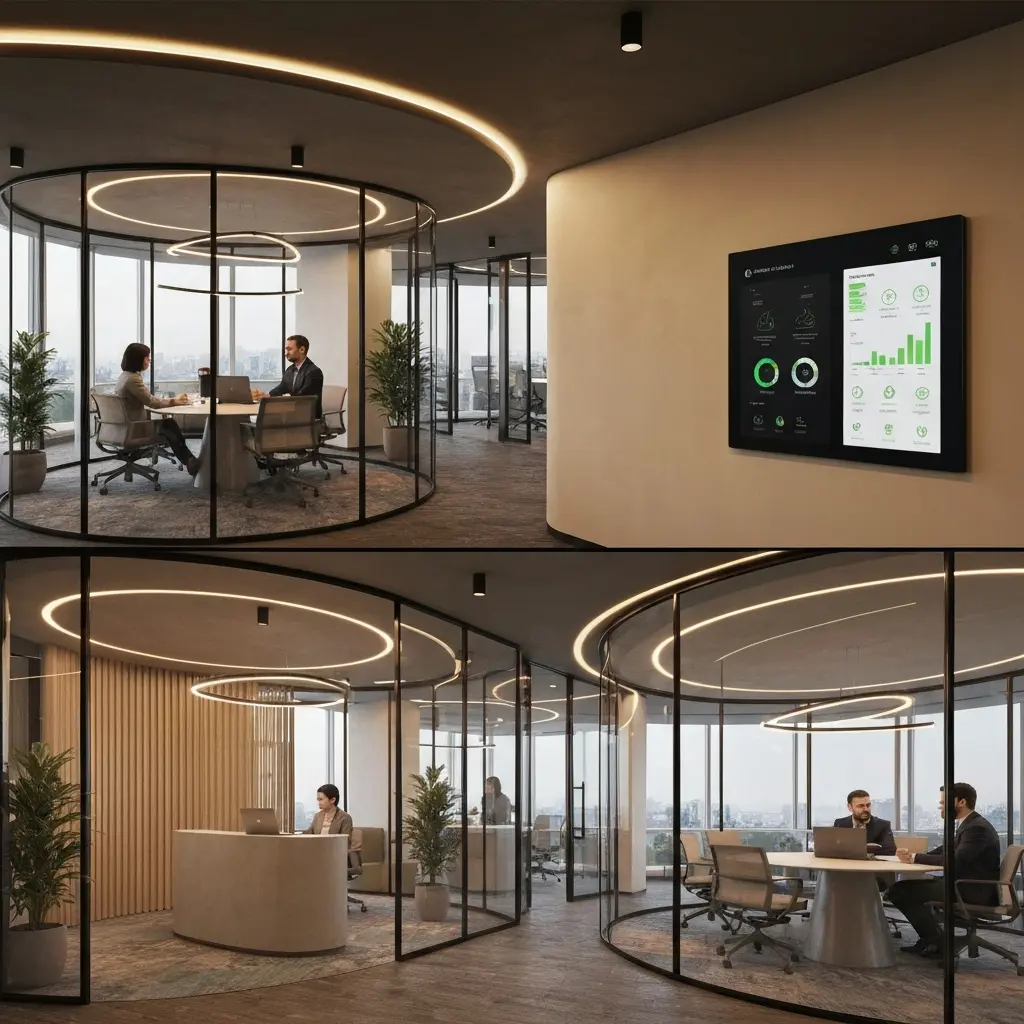
Flexible workspaces that lack real-time energy dashboards are now ineligible for major corporate contracts. This creates a direct advantage for businesses based in certified green spaces. By choosing a workspace that provides granular, auditable energy data, you automatically reduce the reporting burden and compliance risk for your own business and become a more attractive partner to larger, regulated firms.
Crizone Pro Tip: When evaluating a workspace, ask for their energy dashboard demo. A credible operator will show real-time metrics on power consumption, renewable energy usage, and carbon footprint per workstation—data you can directly report to your stakeholders.
| Cost Factor | Traditional Chennai Office (1,000 sq. ft.) | Certified Green Flex Space (10 Dedicated Desks) |
|---|---|---|
| Monthly Base Cost | ₹ 1.5 - 2 Lakhs + GST | ₹ 1.2 - 1.5 Lakhs (all-inclusive) |
| Compliance & Reporting Burden | High (DIY, complex) | Low (provided by operator) |
| Infrastructure CAPEX for Upgrades | High (Owner’s cost) | Zero (Operator’s responsibility) |
| Brand Value & Client Appeal | Standard | Enhanced (Aligned with global ESG standards) |
How LEED v5 Changes the Game from Design to Daily Operations
The latest LEED v5 certification 2026 framework represents a fundamental shift. Previously, certifications could be earned for design intent. Now, LEED v5 mandates that 50% of all points are tied to actual, measured decarbonization and operational performance. For a workspace operator, this means continuous optimization of HVAC, lighting, and waste systems—not just installing them. For your business, it translates to a workspace environment that is not only healthier and more productive but also demonstrably efficient.
This operational focus is crucial in a city like Chennai, where humidity demands high AC usage. Smart, motion-activated HVAC and AI-driven lighting systems in LEED v5 spaces are delivering 15-30% additional energy savings compared to standard setups from just two years ago. This efficiency lowers the operator’s costs, a benefit often reflected in stable membership fees, insulating you from volatile energy price hikes.
Furthermore, LEED v5 introduces the first-ever prerequisite for ‘Operational Carbon Projection.’ This forces operators to model and disclose a long-term decarbonization pathway. Choosing such a space means partnering with a facility committed to net-zero, future-proofing your tenancy against upcoming, stricter Indian regulations.
[Image of a flowchart showing how LEED v5 operational data flows from building systems to a tenant’s ESG report]
Is a Green Lease Essential for Your Company’s Growth?
For 68% of enterprise firms, high-performance “Green Leases” are now a standard procurement requirement. These leases go beyond rent, embedding clauses for mandatory energy data sharing and binding commitments to achieve site-wide energy savings targets, often around 17%. For an Indian growth-stage company, operating within such a framework provides a structured path to sustainability without needing in-house expertise.
This trend is accelerating because sustainable fit-outs are evolving. The concept of “Material Passports”—digital records certifying the low embodied carbon and recyclability of every chair, desk, and partition—is becoming mainstream. When you join a workspace utilizing such materials, you are effectively leasing a circular asset, which significantly reduces the indirect environmental impact of your operations.
The financial implications are clear. February 2026 market data shows a “Green Premium”: LEED-certified flex spaces command up to 11% higher rental rates and 21.4% higher asset valuations. Conversely, the “Brown Discount” is a real risk for assets lacking transparency, with valuations dropping as institutional investors pivot to “data-native” infrastructure. Your office address, therefore, impacts not just your operational efficiency but also your company’s perceived stability and modernity to investors and clients.
Manager Insight: The festive season downtime in India is a perfect example. In a green-flex space, AI systems can power down unused zones completely, achieving savings that benefit all members. In a traditional office, the AC often runs empty, wasting capital.
As noted in JLL India’s 2026 Corporate Real Estate Outlook, “Tenants are increasingly viewing real estate as a service that must deliver on wellness, technology, and sustainability metrics simultaneously. The asset that fails to provide this trifecta faces obsolescence.”
The 2026 Outlook for the Indian Workspace Market
The Indian flexible workspace market will see accelerated consolidation around quality and sustainability in 2026. The bifurcation will deepen, with premium operators who have invested in LEED v5, smart systems, and Energy-as-a-Service (EaaS) models capturing the lion’s share of high-value enterprise demand. EaaS, which allows for net-zero upgrades with zero CAPEX through shared savings, will become a key differentiator. We will see a rise in niche operators catering specifically to ESG-compliant industries like cleantech and fintech. For the Indian occupier, this means more choice in premium, compliant spaces but a growing quality gap in the broader market. Proactively partnering with a forward-thinking operator will be a key business decision.
Key Takeaways
- Compliance is Now a Tenant Issue: Your office choice directly affects your ability to meet client and potential investor ESG due diligence requirements.
- Operational Data is a New Amenity: Prioritise workspaces that provide transparent, real-time data on energy use and carbon footprint.
- Green Leases Mitigate Risk: Seek membership agreements that include sustainability performance clauses to lock in efficiency gains.
- Think Beyond Monthly Cost: Factor in the “Brown Discount” risk and the “Green Premium” advantage for your company’s valuation and brand.
- Future-Proof with Net-Zero Pathways: Align with spaces that have a published, verified plan for long-term decarbonisation.
Conclusion
The workspace landscape has fundamentally shifted. The office is now a strategic tool for managing regulatory risk, enhancing brand value, and driving sustainable growth. For the ambitious Indian business, navigating the Sustainable Flex Bifurcation is not an optional ESG exercise but a critical business strategy. It demands a move from passive tenancy to an active partnership with a workspace provider that embodies these new standards of operational excellence and transparency. At Crizone Business Centre, we are architecting this future today, offering Chennai’s businesses a growth platform designed for the demands of 2026 and beyond—where efficiency, sustainability, and community converge to power your success.
Continue your workspace search
Explore the most relevant Crizone pages next
If this article is part of your Chennai workspace research, these pages help you move from reading into comparing live plans, locations, and fit.
Explore coworking plans in Chennai
Compare day passes, dedicated desks, private offices, meeting rooms, and virtual office options from one commercial hub page.
Book a day pass in Chennai
Best fit if you need occasional workspace access, a short productive break from home, or a flexible desk for a single day.
Compare dedicated desk options
A stronger fit for regular monthly use when you want a fixed seat, better routine, and predictable workspace costs.