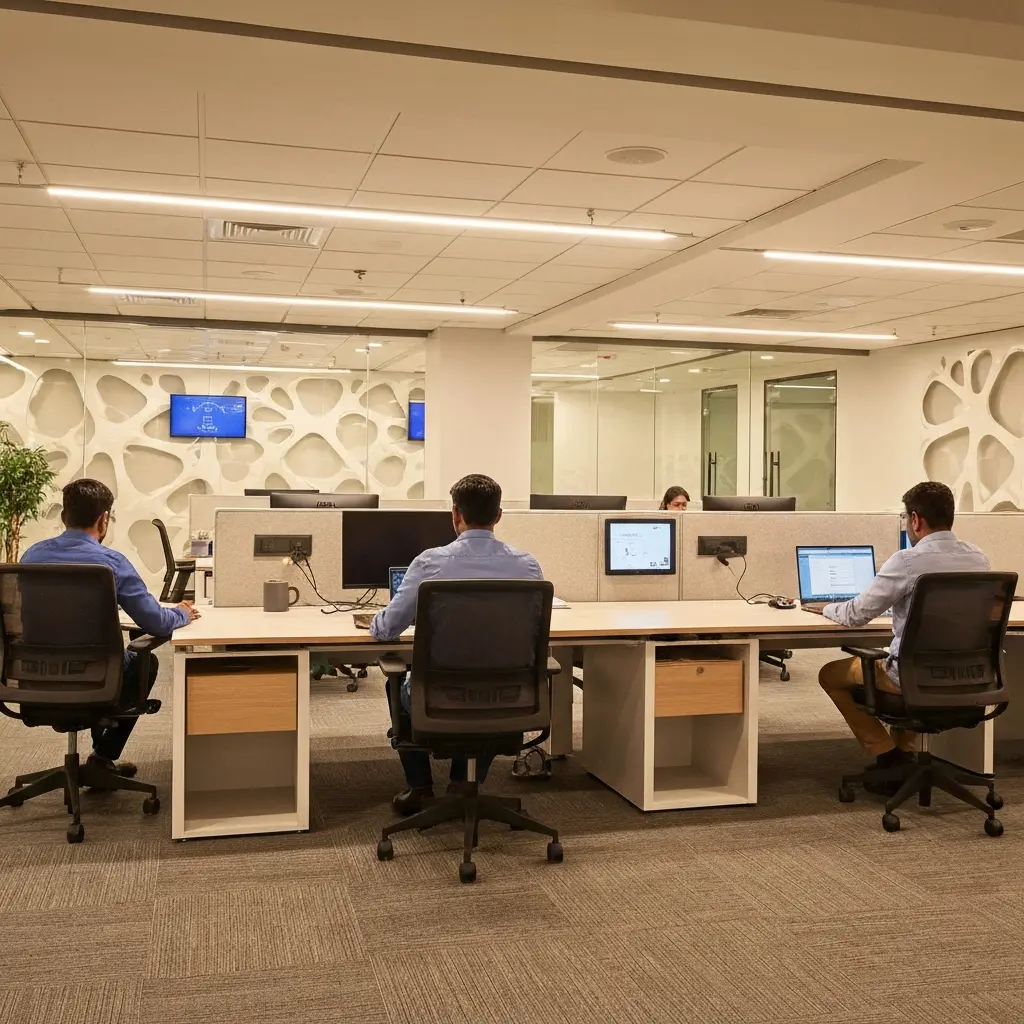
· Business Growth & Workspace · 7 min read
LEED v5 Certification: How Workspaces Prepare for 2026 ESG Rules
By 2026, new ESG reporting rules will change workspace demand in India. LEED v5 certification, focusing on real decarbonization, is the key for businesses to meet mandates, manage costs, and attract top talent.
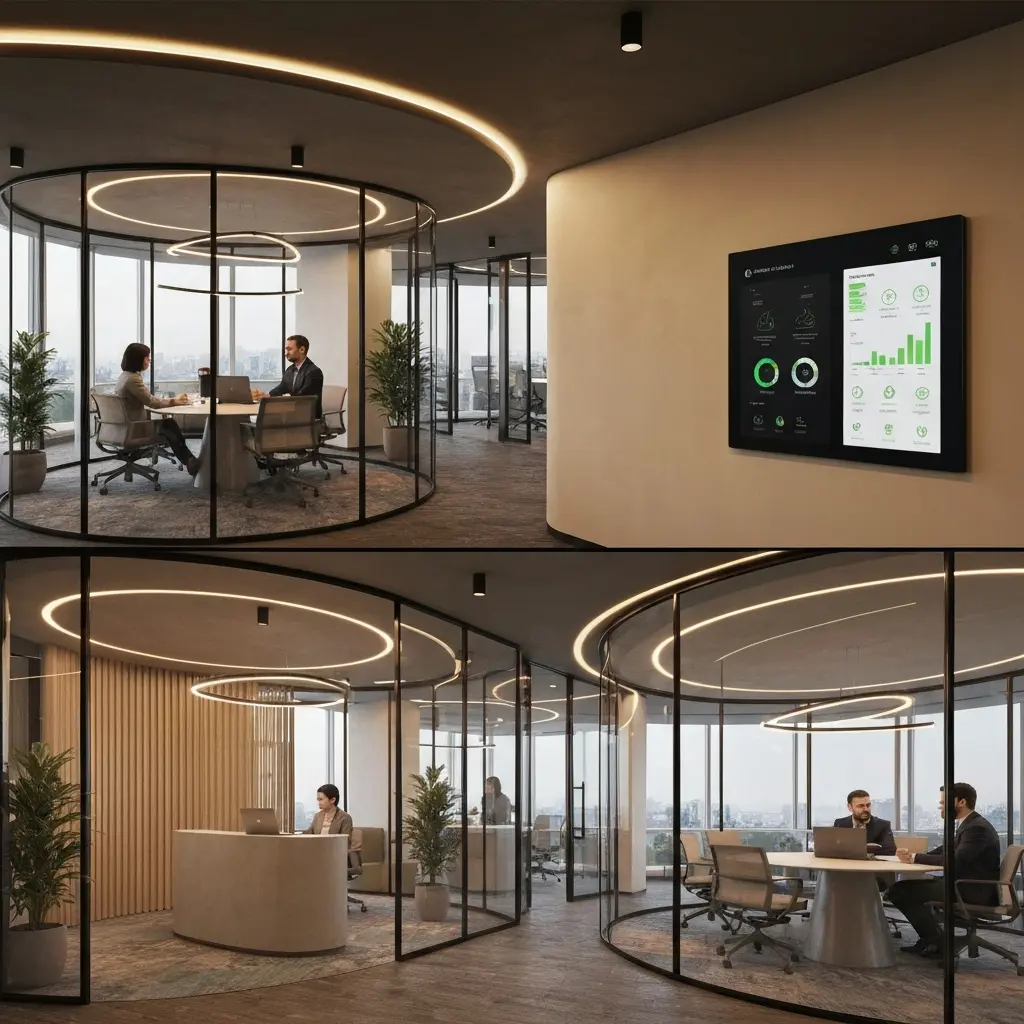
TL;DR: A pivotal shift is here for workspaces. New mandatory ESG reporting in 2026, driven by standards like LEED v5, will directly impact business costs and talent attraction. Operators must move beyond basic energy-saving to full decarbonization and circular fit-outs. Choosing a certified flexible workspace is a strategic growth decision for Indian companies.
Introduction: The New Currency of Business Growth in India
Indian entrepreneurs and corporate leaders are navigating a landscape defined by rising costs, regulatory complexity, and a fierce war for talent. The traditional 5-year office lease, a static capital expense, now competes with a dynamic demand for agility and brand purpose. For companies listed or doing business with global partners, a new operational reality is emerging: mandatory Environmental, Social, and Governance (ESG) disclosures. By 2026, regulations like the EU’s CSRD will effectively extend to Indian suppliers and partners. Your physical workspace will become a critical data point in your corporate ESG report, influencing investor confidence and customer loyalty. This is not a distant concern; it is a present-day strategic pivot. Adopting a robust LEED v5 Certification strategy within your workspace model is no longer a “nice-to-have” sustainability gesture. It is a fundamental lever for business resilience, cost predictability, and talent retention in the coming decade.
What is LEED v5 Certification?
LEED v5 is the latest and most rigorous version of the globally recognised Leadership in Energy and Environmental Design (LEED) green building rating system. Designed specifically to accelerate the built environment’s path to decarbonization, it shifts the focus from design intent to proven, operational performance. It mandates the reporting of embodied carbon in materials and introduces stringent new criteria for energy efficiency, climate resilience, and equity. For businesses, it provides the verified framework needed to report ‘Scope 3’ emissions from their leased spaces, which will be compulsory for many by 2026.
Manager Insight: “In the Indian context, LEED certification was once about premium branding. Now, with LEED v5, it’s about risk mitigation and data compliance. A certified space provides the auditable trail that CFOs and compliance officers will need.”
Why 2026 is a Strategic Deadline for Your Workspace
The first quarter of 2026 is a critical inflection point. Registration for the previous LEED v4 standard closes, forcing all new projects onto the v5 platform. Simultaneously, major corporate ESG reporting mandates come into full force globally. For an Indian SME or startup aiming to attract investment or partner with multinational corporations, this convergence creates both risk and opportunity. The risk lies in being tied to a ‘brown’ asset—a conventional, non-certified office—which may face a ‘brown discount’ in valuation and become a liability on your balance sheet. The opportunity is to leverage a certified flexible workspace as a turnkey solution. It transfers the capital expenditure and operational complexity of achieving net-zero readiness to the operator, while your business reaps the branding and compliance benefits. This is not merely a real estate decision; it is a strategic move to future-proof your business against regulatory and market shifts.
How Decarbonization Strategy Becomes a Cost-Saving Tool
Decarbonization in LEED v5 moves far beyond switching to LED lights. It targets the ‘last 20%’ of energy waste through a ‘New Energy Hierarchy.’ This involves smart building systems that eliminate phantom loads from idle equipment and use AI-enabled HVAC platforms. Early adopters report immediate energy savings of up to 25% by aligning heating and cooling with real-time occupancy data, a significant advantage in Chennai’s climate where AC is a major operational cost. For a business, this directly translates to predictable and often lower service charges, insulating you from energy price volatility.
The financial contrast with a traditional office setup is stark. A conventional lease burdens you with the full capital outlay for inefficient systems and the variable risk of utility spikes.
| Cost Factor | Traditional Chennai Office Lease | LEED v5-Certified Flexible Workspace |
|---|---|---|
| Fit-out Capital | ₹ 20-40 Lakhs (one-time, non-recoverable) | ₹ 0 (included in membership) |
| Energy Efficiency Tech | Your capex & operational headache | Operator’s investment, your savings benefit |
| ESG Reporting Burden | High (you must audit & report everything) | Low (operator provides verified data) |
| Risk of ‘Brown Discount’ | High on your balance sheet | Zero (asset risk held by operator) |
Is Your Supply Chain Ready for Scope 3 Reporting?
For corporate tenants and growth-stage companies eyeing IPOs or global clients, ‘Scope 3’ emissions are the next frontier. These are the indirect emissions from your value chain, which include the energy used in your rented offices. By 2026, over 70% of Fortune 500 companies will demand this data from suppliers. If your workspace operator cannot provide certified, granular data on your space’s carbon footprint, you cannot accurately complete your own mandatory disclosures. This creates compliance risk and can hinder deal flow. A LEED v5-certified flexible workspace solves this proactively. The operator’s investment in IoT-driven predictive sustainability platforms provides you with a real-time dashboard. This doesn’t just track energy use; it stabilises your occupancy costs and supplies the auditable data required for your ESG reports, turning a potential compliance hurdle into a competitive advantage.
Crizone Pro Tip: When evaluating a workspace, ask for their past 12 months of energy consumption data per seat or per square foot. A transparent, tech-forward operator will have this ready, demonstrating true performance over promises.
The Circular Fit-Out: From Cost Centre to Agile Enabler
The concept of a Circular fit-out is central to LEED v5’s embodied carbon mandates. It moves away from the traditional ‘build-use-demolish-waste’ model. In practice, this means workspaces using modular, demountable partitions, furniture from reuse audits, and materials with verified low global warming potential. For your business, the direct benefit is agility. Need to scale your team up for a project or down during a lean period? A circular fit-out allows the workspace to reconfigure your office layout in days, not months, with minimal waste and disruption. This dramatically shortens lead times for office changes and aligns perfectly with the dynamic needs of Indian startups and project-based teams. It also future-proofs your environment against potential future regulations on construction waste.
[Image of Circular Economy in Office Fit-out]
An infographic showing the linear ‘Take-Make-Waste’ office model versus a circular model with loops for reuse, refurbishment, and recycling, highlighting cost and time savings.
The 2026 Outlook for Indian Workspaces
The Indian flexible workspace market will stratify sharply by 2026. Generic, non-certified spaces will compete primarily on price, facing liquidity risks as demand shifts decisively toward sustainable assets. Conversely, premium, LEED v5-certified spaces in lifestyle and transit-oriented locations (like Chennai’s key metro corridors) will command rent premiums of 20-30%, as validated by JLL India’s 2023 Sustainability Report. The operator landscape will consolidate around those who have made the technological and design pivot to v5. For businesses, the choice will be clear: pay a modest premium for a future-proofed, compliant, and talent-attracting workspace, or incur hidden costs and risks in a conventional lease. The workspace will be judged not just by its design, but by its live performance data.
Key Takeaways for Business Leaders
- Mandatory Compliance is Inevitable: ESG reporting, particularly Scope 3 emissions from your office, will transition from voluntary to mandatory for businesses with global ambitions by 2026.
- Certification is a Data Solution: LEED v5 Certification provides the verified performance data you need for compliance, shifting the burden of proof to your workspace operator.
- Agility Comes from Circular Design: Choose spaces with modular, demountable fit-outs. This enables faster, cheaper reconfiguration as your team grows or changes.
- Tech Drives Tangible Savings: Prioritise operators using AI for HVAC and smart building management. This directly lowers and stabilises your operational cost share.
- The ‘Brown Discount’ is Real: Aligning with a non-certified asset poses a financial and reputational risk. Your workspace choice will impact your brand and balance sheet.
Conclusion
The evolution of the workspace is accelerating from a passive cost centre to an active growth partner. The converging deadlines of 2026 make the strategic selection of your business environment more critical than ever. It is a decision that touches finance, compliance, talent strategy, and operational agility. By aligning with a workspace built for the future, you gain more than a desk; you secure a partner in decarbonization, a shield against regulatory complexity, and a platform that attracts the values-driven talent essential for modern growth. For businesses in Chennai looking to navigate this transition with calm efficiency, the path forward is clear.
Ready to explore a workspace designed for the standards of 2026 and the growth of your business? Discover how Crizone Business Centre’s approach to sustainable, agile, and tech-integrated workspaces can be your strategic advantage.
Continue your workspace search
Explore the most relevant Crizone pages next
If this article is part of your Chennai workspace research, these pages help you move from reading into comparing live plans, locations, and fit.
Explore coworking plans in Chennai
Compare day passes, dedicated desks, private offices, meeting rooms, and virtual office options from one commercial hub page.
Book a day pass in Chennai
Best fit if you need occasional workspace access, a short productive break from home, or a flexible desk for a single day.
Compare dedicated desk options
A stronger fit for regular monthly use when you want a fixed seat, better routine, and predictable workspace costs.