· Business Growth & Workspace · 6 min read
Reducing Embodied Carbon: The 2026 Strategy for Sustainable Flex Spaces
Embodied carbon now drives 50% of workspace emissions. Discover how 2026's circular fit-outs, Digital Product Passports, and Green Leases offer Indian businesses a competitive edge.
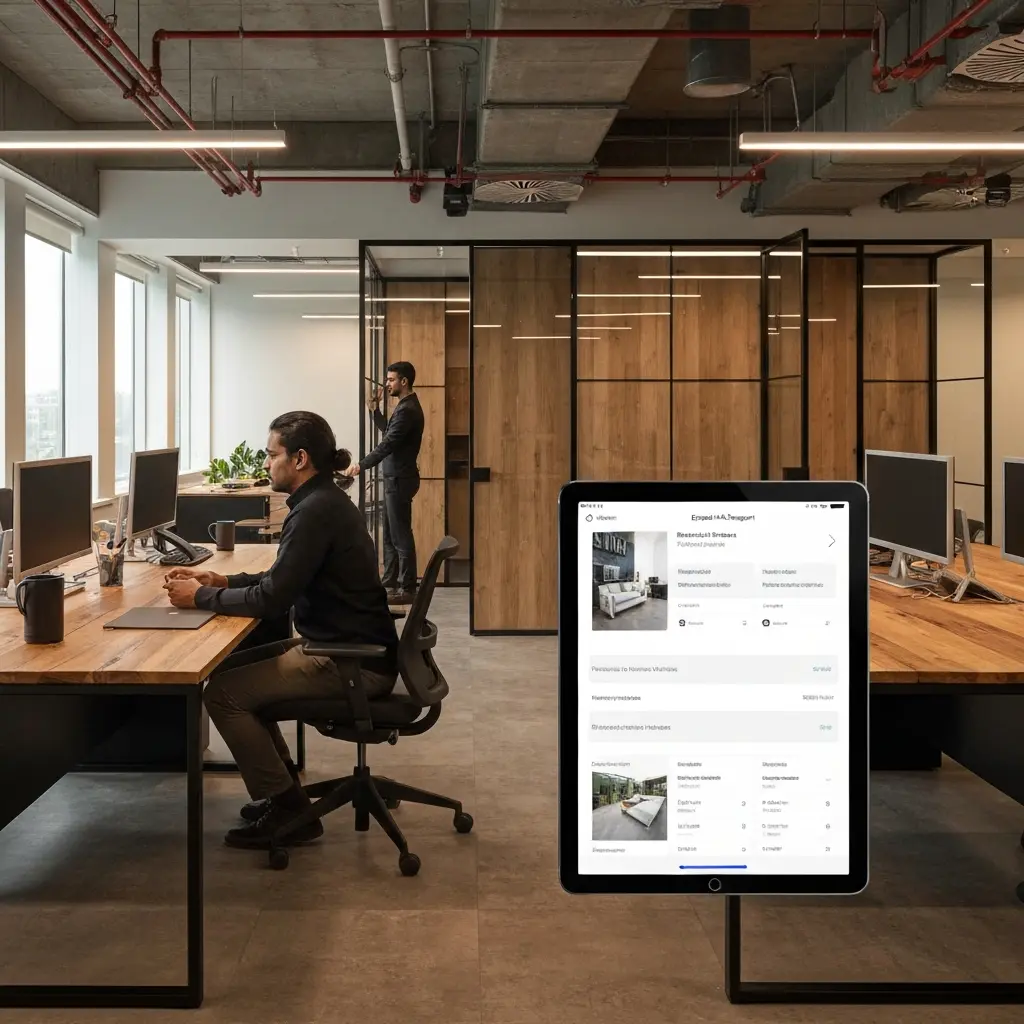
TL;DR: For Indian businesses in 2026, a workspace’s true carbon cost lies in its construction materials. A new playbook focused on Embodied Carbon, circular fit-outs, and verifiable ESG data is emerging. It slashes costs, de-risks supply chains, and meets stringent corporate sustainability mandates, turning your office from a liability into a growth asset.\n\nFor the modern Indian founder, growth is a battle fought on multiple fronts. Between navigating Chennai’s OMR traffic, managing volatile CAPEX, and attracting top talent who now scrutinise a company’s green credentials, the traditional office lease is a strategic anachronism. It locks you into static spaces, burdens you with fit-out waste, and offers little defence against rising ESG (Environmental, Social, and Governance) scrutiny from investors and clients. The flexible workspace revolution solved the agility problem, but a new, invisible challenge has taken centre stage: the carbon baked into the very walls, floors, and furniture of your office. The frontier of competitive advantage in 2026 is not just where you work, but what your workspace is made of.\n\n## What is Embodied Carbon?\n\nEmbodied Carbon refers to the greenhouse gas emissions associated with the entire lifecycle of building materials, from raw material extraction and manufacturing to transportation, construction, and eventual demolition or disposal. Unlike operational carbon from energy use, these are ‘upfront’ emissions, locked in the moment your office fit-out is complete. For a modern flex space, this can constitute up to 50% of its total lifetime carbon footprint, making material choices as critical for net-zero goals as energy-efficient air conditioning.\n\n### From Demolition to Deconstruction: The Rise of the Circular Fit-out\n\nThe era of ‘strip and dump’ renovations is ending. Forward-thinking operators now begin every project with a mandatory ‘Day 0’ reuse audit. This process meticulously catalogues existing furniture, partitions, and technical systems to determine what can be refurbished, repurposed, or remanufactured. The result is a direct 30-40% reduction in both Embodied Carbon and project lead times. For an Indian SME, this translates to faster move-in and a significant shield against the CAPEX volatility of new materials, whose costs can swing with global supply chains and festive season slowdowns.\n\n> Crizone Pro Tip: Before your next office move or refresh, conduct a simple internal audit. Can desks be refinished? Can meeting room partitions be reconfigured instead of replaced? This mindset directly lowers your project’s carbon and financial footprint.\n\nThe strategic shift is toward modular, demountable systems. Think of office layouts built with interlocking, ‘zero-concrete’ components that can be easily rearranged as your team grows or contracts. This prevents the waste typical of traditional 3-year leases and aligns perfectly with the dynamic needs of a scaling startup.\n\n| Aspect | Traditional Chennai Office Fit-Out (2026) | Circular Flex-Space Fit-Out (2026) |\n| :--- | :--- | :--- |\n| Material Sourcing | New, virgin materials; global supply chain. | 40-60% refurbished/second-life items; local circular market. |\n| Construction Waste | High (15-20% to landfill). | Low (<5%); designed for deconstruction. |\n| Project Timeline | 3-4 months, dependent on new material delivery. | 6-8 weeks, leveraging pre-audited, available stock. |\n| CAPEX Risk | High exposure to material cost volatility. | Hedged through circular procurement. |\n\n### Digital Traceability and The New Rules of Engagement\n\nHow can you trust a sustainability claim? Enter the Digital Product Passport (DPP). By 2026, over 70% of office furniture manufacturers provide these digital ledgers. A DPP details a chair’s or desk’s material origin, carbon footprint, and end-of-life recyclability, offering verifiable proof for your ESG reports. This traceability is becoming non-negotiable.\n\nThis demand is crystalised in the Green Leases 2026 evolution. Nearly 80% of enterprise tenants now require guaranteed, transparent data sharing on energy, water, and waste as a standard lease clause. For a branch manager in Chennai, this means your corporate headquarters will increasingly mandate proof of sustainable operations from your local office. Partnering with a workspace provider that has this data infrastructure built-in is no longer a ‘nice-to-have’ but a compliance essential.\n\n[Image of a Digital Product Passport dashboard on a tablet, showing a chair’s material breakdown, carbon footprint, and recycling instructions]\n\n### Is Your Workspace Actively Optimising for You?\n\nThe strategy doesn’t stop at move-in. Post-Occupancy Optimization (POE) uses IoT sensors—now in 55% of global flex spaces—to collect real-time data on space usage. This intelligence allows operators to ‘right-size’ floorplans, automatically power down underutilised zones, and reduce daily energy waste by 20%. For your business, this means your operational costs are continuously optimised, and the carbon intensity of your team’s footprint drops by a further 12-15% without any effort on your part.\n\nThe financial alignment is clear in the rise of management agreements, where landlord and operator share long-term utility savings. This model incentivises deep investment in smart, sustainable infrastructure from day one, benefits that are passed directly to you as a member.\n\n> Manager Insight: “The global market for remanufactured office furniture is now a $34 billion industry. Choosing a workspace partner invested in this circular economy isn’t just an ESG win; it’s a strategic buffer against material shortages and price spikes that can disrupt your growth timeline.”\n\n## The 2026 Outlook for Indian Workspaces\n\nThe Indian flexible workspace market will see a decisive split in 2026. Generic spaces will compete on price, while premium operators will compete on verifiable Flex Space ESG performance. We predict a surge in demand for spaces that provide audited embodied carbon data for their fit-outs, mandated by both multinational tenants and discerning Indian founders. Chennai, with its growing corporate corridors, will see leaders adopt smart, circular design not just for ethics, but for economic resilience, talent attraction, and superior operational control, turning sustainability into a tangible balance-sheet advantage.\n\n## Key Takeaways\n\n- Scrutinise the Unseen: When evaluating a workspace, ask for data on its fit-out’s Embodied Carbon and policies on circular design.\n- Demand Digital Proof: Prioritise providers that use Digital Product Passports for furniture, ensuring transparency for your own ESG reporting.\n- Think Modular & Flexible: Opt for demountable partitions and adaptable layouts to avoid the cost and waste of future renovations.\n- Leverage Smart Optimisation: Choose spaces with IoT-driven systems that actively reduce energy waste, lowering your indirect operational carbon.\n- Anticipate Green Mandates: Prepare for Green Leases 2026 by partnering with a centre that has robust utility monitoring and data-sharing protocols in place.\n\n## Conclusion\n\nThe workspace of 2026 is measured not just in square feet, but in kilograms of carbon avoided. The strategic shift from operational efficiency to embodied carbon management represents a profound opportunity for Indian businesses. It allows you to future-proof your operations against regulatory shifts, appeal to a values-driven workforce, and build a brand synonymous with responsible growth. This is the new baseline for a competitive, modern enterprise. At Crizone Business Centre, we are integrating these very principles of circular design, material traceability, and smart optimisation into our Chennai centres, providing a foundation where your business growth and sustainability goals are seamlessly aligned. Let’s build a more efficient future, together.
Continue your workspace search
Explore the most relevant Crizone pages next
If this article is part of your Chennai workspace research, these pages help you move from reading into comparing live plans, locations, and fit.
Explore coworking plans in Chennai
Compare day passes, dedicated desks, private offices, meeting rooms, and virtual office options from one commercial hub page.
Book a day pass in Chennai
Best fit if you need occasional workspace access, a short productive break from home, or a flexible desk for a single day.
Compare dedicated desk options
A stronger fit for regular monthly use when you want a fixed seat, better routine, and predictable workspace costs.