· Business Growth & Workspace · 6 min read
Managed Office Suites: How Enterprises Are Expanding in Chennai 2026
Latest global data reveals a 'Great Recalibration': enterprises are expanding through managed suites. Learn how this trend offers agility for Chennai's SMEs and branch managers.
TL;DR: Global enterprises are reversing earlier downsizing by expanding their footprint through agile managed office suites. This trend offers Indian businesses a strategic middle ground between traditional leases and coworking, enabling rapid growth without the heavy capital lock-in of a conventional office.
Introduction: The Agility Imperative for Indian Businesses
For Indian entrepreneurs, SME founders, and branch managers, the question of where to operate is more critical than ever. Rising commercial rents in hubs like Chennai’s OMR, coupled with the need for talent retention and operational flexibility, make the traditional 10-year lease a significant constraint. The global corporate real estate (CRE) landscape is undergoing a pivotal shift, directly relevant to India’s growth-focused businesses. After a period of “space shedding,” enterprises are now entering a ‘Great Recalibration,’ seeking to optimise their physical presence for productivity and expansion. This recalibration is not a return to the old model but a strategic pivot towards high-density, brand-integrated managed office suites that offer the privacy of a traditional office with the agility of a coworking contract.
What is a Managed Office Suite?
A managed office suite is a self-contained, fully serviced, and often branded private workspace within a larger flexible business centre. It provides a dedicated, lockable space—typically for teams of 6 to 50—with customisable interiors, private meeting rooms, and administrative support. Unlike a shell-and-core traditional lease, it comes fully fitted and managed, offering a middle-ground commitment of around 3.5 years. This model combines the operational autonomy of a traditional office with the financial and logistical agility of a flexible workspace contract, making it a primary vehicle for enterprise flex expansion in 2026.
Why Managed Suites Are the Engine for 2026 Portfolio Expansion
Global data shows 70% of corporate real estate leaders plan to expand their office footprint this year, with 44% using flexible workspace as their primary tool. For an Indian SME, this trend translates into a powerful growth lever. A managed suite allows a company to establish a professional, branded headquarters or branch office in a premium location like Chennai’s Mount Road without the upfront capital expenditure of ₹50-100 Lakhs for fit-outs, furniture, and security systems. The 3.5-year average term provides stability for team building and client trust, while avoiding the decade-long lock-in that can stifle scalability.
Business Growth Tip: For a Chennai-based SME planning a second location, consider a managed suite in a business centre with strong metro connectivity. It allows you to establish a presence in a new micro-market (e.g., Anna Nagar) within weeks, testing demand before committing to a larger, traditional lease.
[Image of a cost comparison chart showing Traditional Lease vs. Managed Suite]
| Cost Factor | Traditional Chennai Office Lease (5,000 sq ft) | Managed Office Suite Solution |
|---|---|---|
| Fit-out & Furniture | ₹15-25 Lakhs (CAPEX) | Included in monthly fee (No CAPEX) |
| Annual Maintenance | ₹3-5 Lakhs (AC, Cleaning, Security) | Included in monthly fee |
| Commitment Term | 8-10 Years | ~3.5 Years (42 Months) |
| Administrative Staff | Hiring & Management Overhead | Provided (Front Desk, IT Support) |
| Scalability | Fixed; expansion requires new lease | Ability to add adjacent suites or hot desks |
Is Your Meeting Space Design Holding Back Productivity?
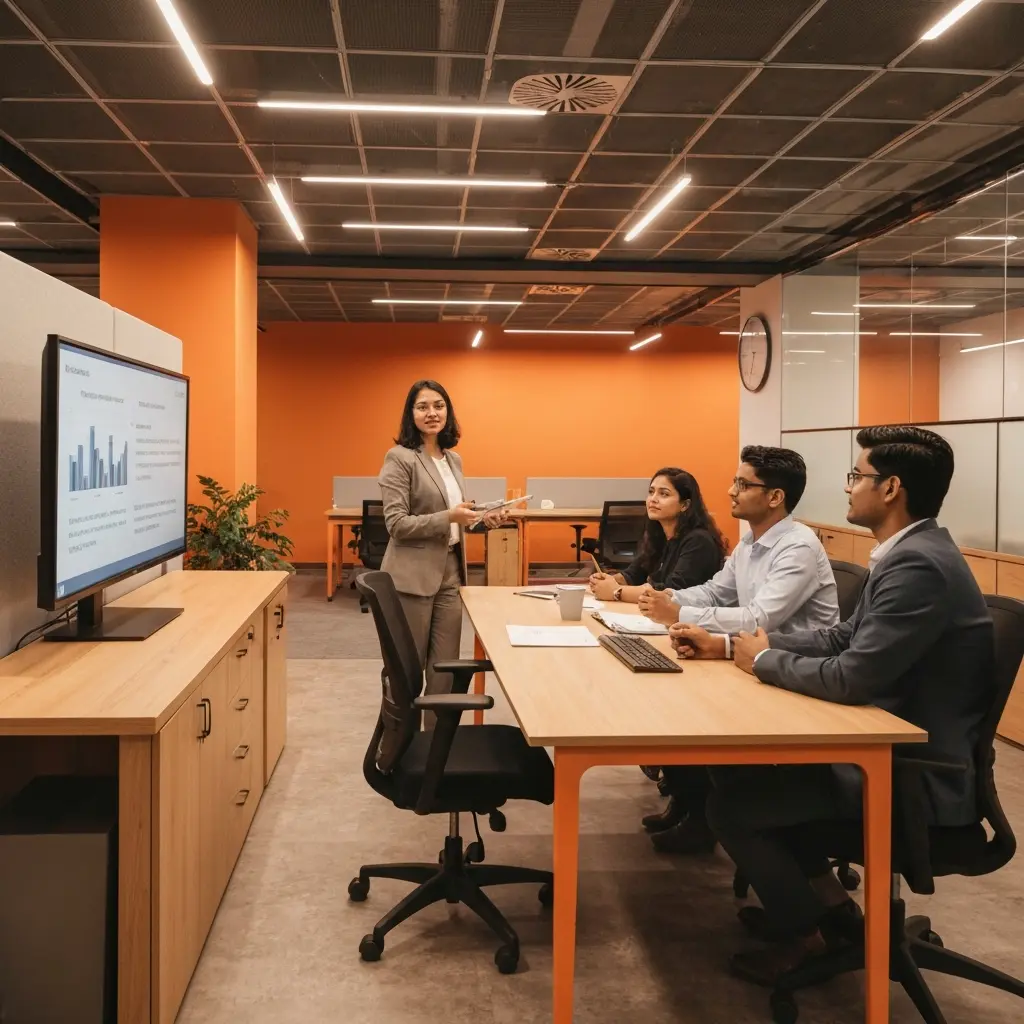
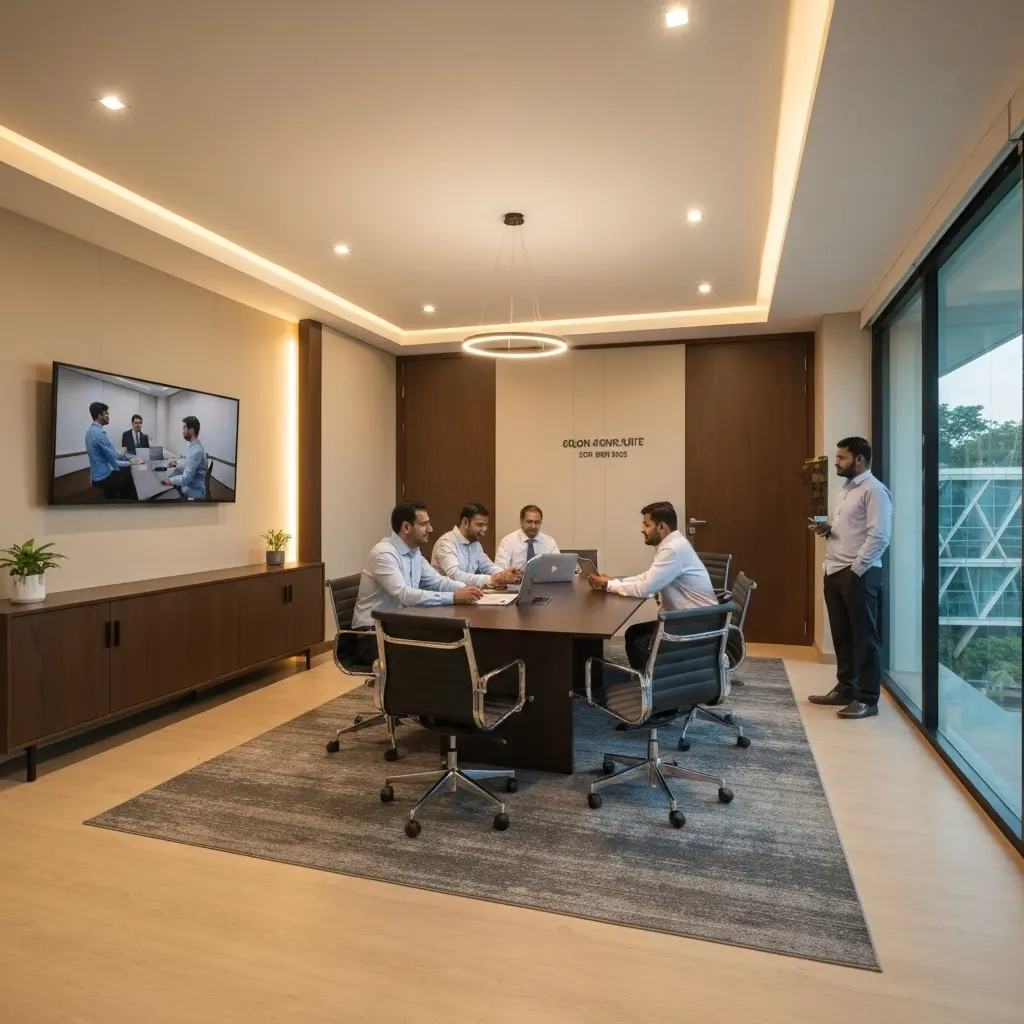
A critical insight from occupier behaviour is the design mismatch in traditional offices. While 78% of all enterprise meetings involve 6 people or fewer, large boardrooms are underutilised. In the Indian context, this inefficiency is compounded by the cultural importance of collaborative, yet intimate, discussions. A managed suite within a quality business centre is designed for this reality. It provides dedicated, well-equipped meeting rooms sized for 4-8 people, alongside access to larger event spaces for occasional town-halls. This optimises your operational cost per productive meeting hour and eliminates the wasted space of a seldom-used 17-seat boardroom.
Manager Insight: “For our Chennai branch, moving to a managed suite meant our team could book a fit-for-purpose meeting room in 30 seconds via an app, rather than coordinating with a building manager. It cut pre-meeting friction dramatically,” says a regional director for a national insurance firm.
The Fractional HQ: A Strategic Model for Indian Market Entry
The concept of a ‘Fractional HQ’ is gaining traction globally, particularly with tech and BFSI firms decentralising. For an international corporation entering the Indian market, or an Indian startup aiming to establish a premium presence, a managed suite acts as this fractional headquarters. It offers the full aura and functionality of a corporate office—branded signage, executive cabins, client接待 areas—but on a fraction of the real estate and at a fraction of the operational headache. This aligns with data showing 78% of enterprise searches for spaces under 5,000 sq ft now demand ‘managed or fitted’ solutions, rejecting the shell-and-core approach that delays market entry by 6-12 months.
The 2026 Outlook for India’s Workspace Market
The Indian flexible workspace market is poised to mirror and accelerate this global trend. As reported by JLL India, the demand for managed and fitted office solutions from enterprises and large SMEs is rising sharply in cities like Chennai, Bengaluru, and Mumbai. We predict 2026 will see a surge in ‘high-density flex clusters’—business centres that offer a mix of managed suites, coworking, and event spaces—become the default choice for companies executing growth or correction strategies. Institutional ‘right-sizing,’ as seen with global banks, will translate to Indian corporations optimising their Chennai and Hyderabad portfolios through agile, medium-term commitments in premium flex locations, skipping the traffic bottlenecks of traditional commercial districts.
Key Takeaways
- Agility is Strategic: Portfolio expansion via managed suites offers a 3.5-year middle ground, providing stability for growth without the decade-long lock-in of a traditional lease.
- Design for Reality: Optimise your meeting space cost and productivity by moving to an environment designed for the modern 6-person meeting, not the oversized boardroom.
- Fractional Presence: Use a managed suite as a ‘Fractional HQ’ to establish a premium, branded presence in a new market with minimal capital expenditure and lead time.
- Cost Transparency: Shift from unpredictable CAPEX (fit-out, furniture) and OPEX (maintenance staff) to a single, predictable monthly operational fee covering workspace, admin, and amenities.
- Correct Past Decisions: If your 2024-2025 remote shift caused productivity losses, consider a managed suite as a calibrated, professional physical anchor to rebuild team cohesion and culture.
Conclusion: Calibrating Your Growth with the Right Space
The data confirms a decisive shift: strategic growth is now facilitated by agile, managed workspace, not constrained by rigid, capital-intensive leases. For the Indian entrepreneur, this recalibration offers a path to scale with precision, maintaining brand integrity and operational control while shedding the financial burdens of traditional real estate. It allows you to focus on your business, not your building’s maintenance or your lease’s expiry. At Crizone Business Centre, we provide this exact, calmly efficient solution for Chennai’s ambitious businesses—from fully-branded managed suites for growing teams to fractional HQ setups for market entrants—all designed to be your growth partner in 2026 and beyond.
Continue your workspace search
Explore the most relevant Crizone pages next
If this article is part of your Chennai workspace research, these pages help you move from reading into comparing live plans, locations, and fit.
Explore coworking plans in Chennai
Compare day passes, dedicated desks, private offices, meeting rooms, and virtual office options from one commercial hub page.
Book a day pass in Chennai
Best fit if you need occasional workspace access, a short productive break from home, or a flexible desk for a single day.
Compare dedicated desk options
A stronger fit for regular monthly use when you want a fixed seat, better routine, and predictable workspace costs.