· Business Growth & Workspace · 6 min read
Capacity-as-a-Service: How Chennai's Top Businesses Gain Agility in 2026
By 2026, 60% of Fortune 500 firms use Capacity-as-a-Service. Discover how Indian SMEs can trade fixed costs for SLA-backed, on-demand office space to drive growth.
TL;DR: The 2026 corporate landscape has pivoted. Leading enterprises now treat workspace as a utility, purchasing on-demand capacity backed by service-level guarantees (SLAs). This Capacity-as-a-Service model offers Indian businesses portfolio liquidity, significant cost savings, and the agility to scale teams and test markets without traditional leases.
For Indian founders and branch managers, the challenge is consistent: scaling a business while managing escalating fixed costs. A traditional five-year office lease in Chennai, with its hefty security deposit and capital expenditure for fit-outs, ties up crucial liquidity. It locks you into a fixed asset while your talent pool demands flexibility and your growth trajectory remains uncertain. The market has responded. By 2026, the demand is not for mere square footage, but for guaranteed performance—reliable internet, secure spaces, and environments that support wellness and productivity.
What is Capacity-as-a-Service?
Capacity-as-a-Service (CaaS) is a procurement model where corporations purchase on-demand access to workspace and its accompanying infrastructure, governed by rigorous Service-Level Agreements (SLAs). Instead of a long-term lease for a fixed space, companies buy ‘flex credits’ or pre-paid capacity. This converts office space from a capital-intensive, fixed asset into a scalable, high-performance utility, with guarantees on everything from IT uptime and air quality to security protocols.
Why Your Balance Sheet Demands an Agile Workspace Strategy
The primary driver for the shift to CaaS is financial efficiency. For an Indian SME, committing ₹25-50 Lakhs upfront for a traditional office fit-out represents significant, illiquid capital. This model flips that script, converting heavy capital expenditure (CapEx) into predictable operational expenditure (OpEx). Large enterprises report average real estate cost savings of 25% by adopting such flexible models. This freed-up capital can be redirected towards R&D, marketing, or talent acquisition—areas that directly fuel growth.
A cost comparison for a 20-person team in Chennai illustrates the shift:
| Cost Factor | Traditional Office (Annual) | Capacity-as-a-Service / Premium Flex (Annual) |
|---|---|---|
| Base Rent (OMR/Anna Salai) | ₹18-24 Lakhs | ₹12-18 Lakhs (in flex credits) |
| Fit-Out & Furniture (CapEx) | ₹8-12 Lakhs (one-time) | ₹0 (included in service) |
| IT/Internet Infrastructure | ₹2-4 Lakhs + management | ₹0 (SLA-backed, included) |
| Maintenance & Housekeeping | ₹2-3 Lakhs | ₹0 (included in service) |
| Total Financial Outlay | High CapEx, Fixed Cost | Predictable OpEx, Scalable |
Manager Insight: “Treating workspace as OpEx isn’t just an accounting trick. It’s a strategic tool for portfolio liquidity. It allows a Chennai-based IT firm to pilot a 10-person team in Bangalore using flex credits, without the risk of a multi-year lease, aligning cost perfectly with a new project’s lifecycle.”
From Fixed Floors to Flexible Credits: The New Corporate Toolkit
The modern enterprise toolkit includes Enterprise Flex Credits. These are not mere memberships; they are a currency for agile expansion. Data shows 72% of global businesses use such credits to test new regional markets and talent pools before committing to permanent infrastructure. For an Indian product company eyeing the European or US market, this means deploying a small sales team via a partner network like Crizone’s, validating the market with minimal risk. The credits provide access to enclosed, private offices—which are projected to dominate 45.6% of the global coworking market in 2026—ensuring the privacy and acoustic insulation required for focused team work.
Furthermore, the asset-light expansion model has become standard. Forty percent of new flexible workspace locations now operate under Management Agreements, where landlords and operators share revenue and risk. This alignment ensures operators are incentivised to maintain impeccable standards, directly benefiting the enterprise client who relies on those SLAs. This trend is accelerating in Indian metros, where premium business centre providers partner with Grade-A commercial property owners.
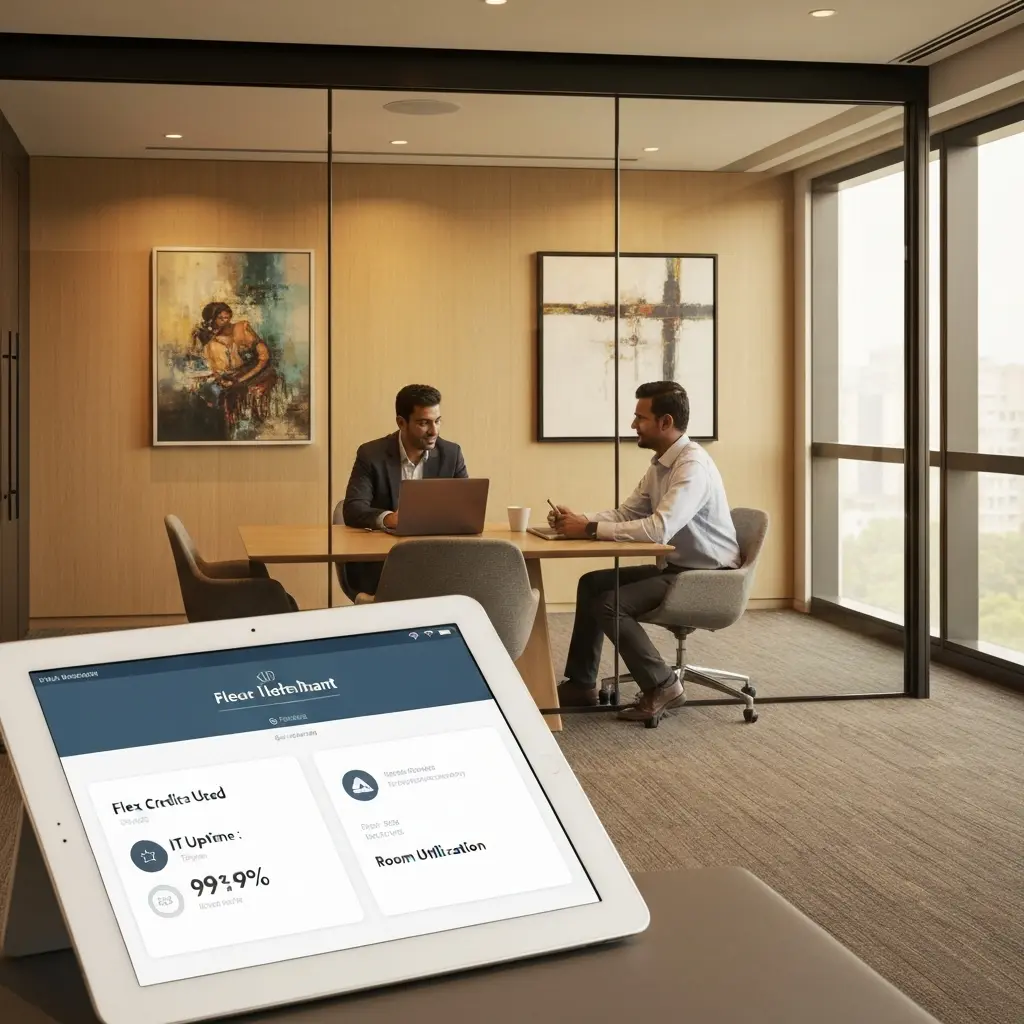
[Image of CaaS Flex Credit Dashboard] An illustration of an enterprise dashboard showing flex credit balances, usage across different locations (Chennai, Mumbai, Pune), and SLA compliance metrics like network latency and meeting room availability.
Is Advanced Technology Now Your Primary Workspace Requirement?
For the IT/ITES sector—which drives over 35% of flexible office demand—the answer is a resounding yes. CEO-led technology mandates are decisive; 77% of business leaders cite advanced tech infrastructure as the key reason for choosing premium flex over traditional offices. This goes beyond high-speed internet. It encompasses guaranteed uptime (99.9% SLAs), enterprise-grade cybersecurity, seamless video conferencing systems, and smart building management that adapts to Chennai’s humid climate.
The stabilized ‘Mid-Week Peak’ pattern, with teams averaging 3 office days per week, makes synchronized, tech-enabled meeting rooms a critical asset. A 65% occupancy rate for these spaces underscores their value. When your development team in Coimbatore needs to collaborate with your UX designers in Chennai, the workspace must disappear as a friction point and become a seamless productivity platform.
Crizone Pro Tip: When evaluating a CaaS provider, scrutinise the SLA. Ask for historical uptime reports for their internet and power backup. In Chennai, where sudden showers can disrupt connectivity, a robust SLA isn’t a luxury—it’s the foundation of business continuity.
The 2026 Outlook for India’s Workspace Market
The Indian flexible workspace market will deepen its corporate penetration in 2026. We will see a sharper bifurcation: a growing demand for premium, SLA-backed enterprise solutions versus more casual, open-plan options. Operators will diversify revenue, with 30% of income coming from virtual offices, event rentals, and premium F&B—services that Indian SMEs can leverage to build a professional brand presence without a full-time office. As noted in a recent JLL India report, the flight to quality and flexibility will intensify, with managed office spaces becoming the default for growth-stage companies seeking to attract and retain top talent while optimizing real estate costs.
Key Takeaways
- Convert fixed real estate CapEx into agile OpEx, preserving capital for core business growth.
- Use Enterprise Flex Credits as a strategic tool for low-risk market expansion and talent access beyond your home city.
- Prioritise Service-Level Agreements (SLAs) on IT, security, and maintenance over mere square footage.
- Leverage the enclosed, private office solutions within flexible ecosystems to provide teams with the focus and privacy modern work requires.
- Choose a partner whose asset-light, management agreement model aligns their success with the performance and reliability of your workspace.
Conclusion
The evolution from leasing space to purchasing guaranteed capacity represents a fundamental shift in business strategy. It aligns physical infrastructure directly with operational agility and financial health. For the ambitious Indian business, this model offers a decisive edge: the ability to scale teams, enter new markets, and leverage top-tier technology without the drag of a traditional lease.
This is precisely the growth-partner philosophy at the core of Crizone Business Centre. We provide Chennai’s entrepreneurs and enterprises with precisely calibrated, SLA-backed workspace solutions—from private offices to flex credits—that turn real estate from a fixed cost into a dynamic engine for your business’s next chapter.
Continue your workspace search
Explore the most relevant Crizone pages next
If this article is part of your Chennai workspace research, these pages help you move from reading into comparing live plans, locations, and fit.
Explore coworking plans in Chennai
Compare day passes, dedicated desks, private offices, meeting rooms, and virtual office options from one commercial hub page.
Book a day pass in Chennai
Best fit if you need occasional workspace access, a short productive break from home, or a flexible desk for a single day.
Compare dedicated desk options
A stronger fit for regular monthly use when you want a fixed seat, better routine, and predictable workspace costs.