· Business Growth & Workspace · 6 min read
Neuro-Inclusive Office Design: 2026 Coworking Trends for Indian Business Growth
Discover how the 2026 neuro-adaptive workspace strategy addresses sensory overload with biophilic ecosystems and sensory zoning, helping Indian SMEs attract talent and boost productivity.
TL;DR: In 2026, top coworking spaces adopt neuro-inclusive office design to combat sensory overload. Key strategies include sensory zoning, circadian biophilia, and modular autonomy nodes. These features support a diverse workforce and enhance cognitive performance, a critical edge for growing Indian businesses navigating hybrid work.
For Indian founders and managers, the greatest operational bottleneck in 2026 may not be funding or talent alone, but the workspace itself. The traditional, uniform open-plan office often creates a battle against distraction, especially in bustling cities like Chennai. This sensory friction directly impedes the deep focus required for strategy and innovation. Concurrently, the compressed, 77-month average office lease cycle demands unprecedented agility. The workspace solution is no longer about square footage but about cognitive performance. The 2026 frontier, therefore, is the neuro-inclusive office design, transforming physical space into a strategic growth partner.
What is Neuro-Inclusive Office Design?
Neuro-inclusive office design is a strategic approach to workspace architecture and management that actively supports diverse neurological needs. It moves beyond basic ergonomics to shape sensory inputs—light, sound, texture, and spatial organisation—to enhance focus, reduce stress, and boost overall cognitive performance. The goal is to create environments where both neurotypical and neurodivergent professionals can sustainably achieve their best work, making it a core component of 2026 coworking design trends.
Is Your Workspace Creating Sensory Friction for Your Team?
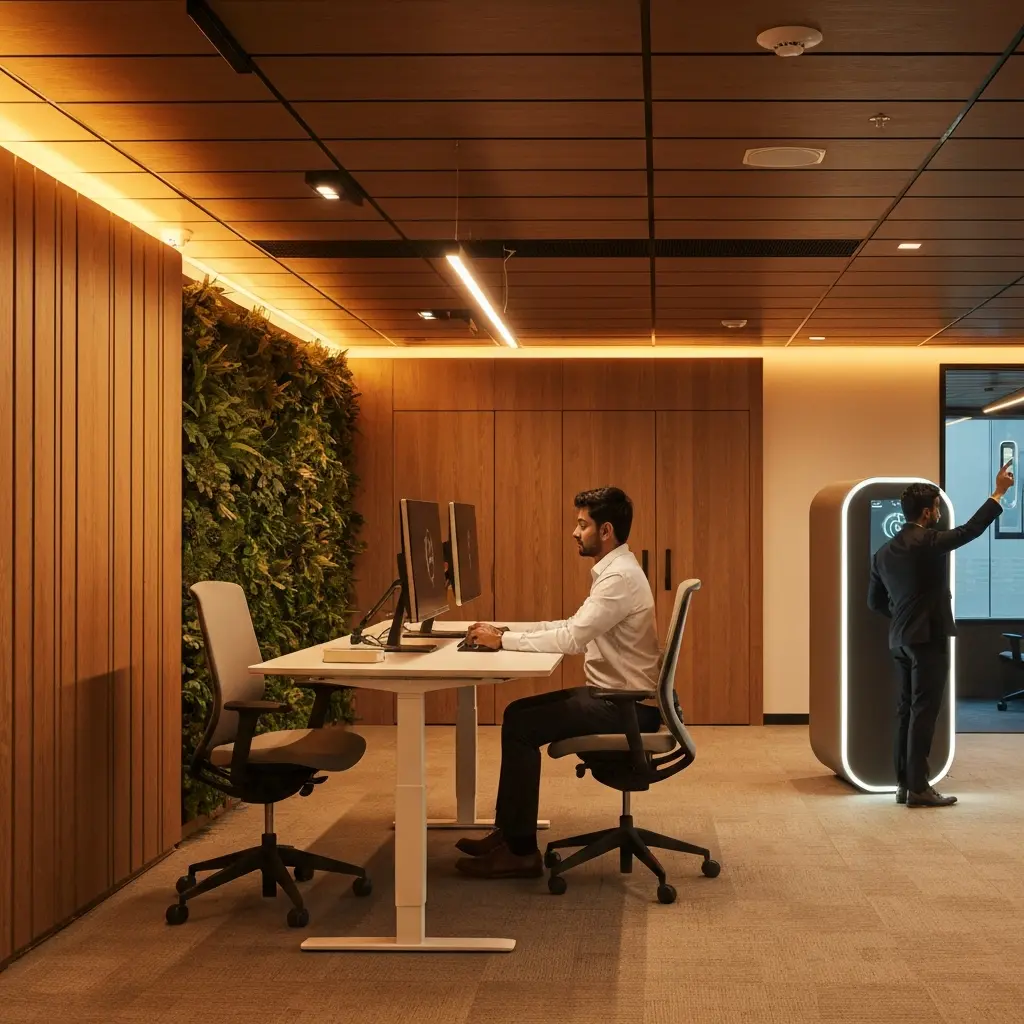
The open-plan era has reached a breaking point. Market data indicates that 1 in 7 workers are neurodivergent, meaning a generic one-size-fits-all approach is a liability. Leading spaces now implement ‘Sensory Profiles’ for distinct zones. This is not just a quiet room; it’s a deliberate spectrum from high-stimulus collaboration hubs to deeply low-stimulus focus pods. For an Indian SME, this directly translates to talent retention and productivity. A developer who needs silence can thrive, while a creative team can brainstorm without constraints, all within the same facility.
Crizone Pro Tip: Assess your team’s workflow. Do they have access to both collaborative ‘energy’ zones and restorative ‘focus’ pods within their day? This intentional variety prevents burnout and fuels sustained innovation.
Crucially, acoustic ‘pods’ are evolving into ‘Autonomy Nodes.’ Data confirms that giving individuals environmental control over their immediate space—light, sound, privacy—significantly lowers cortisol levels. In a market where talent is mobile, offering this level of personal agency can be a decisive factor in attracting top performers tired of the chaos of traditional setups or the isolation of home offices.
How Can Biophilic 2.0 and Tactile Design Fuel Business Agility?
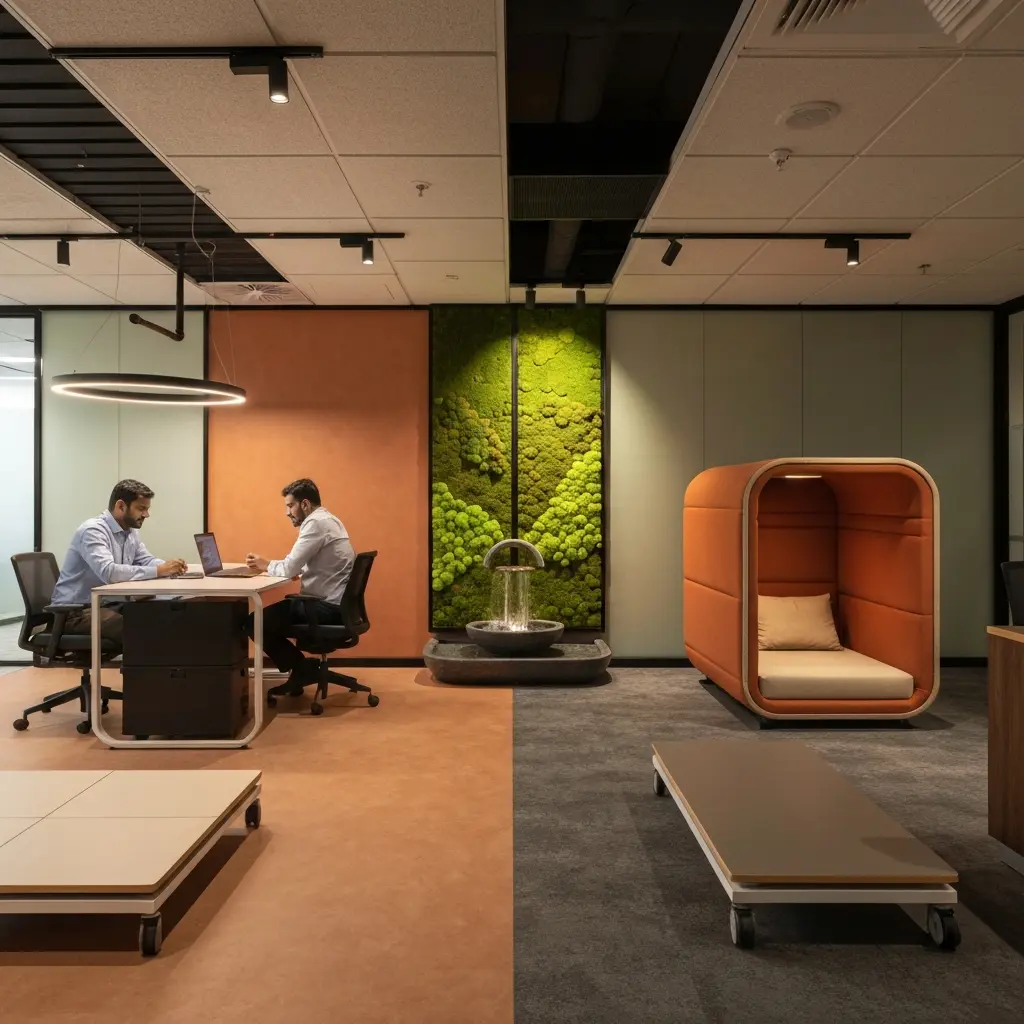
Sustainability and wellness have merged into ‘Operational Circularity.’ 2026 design prioritises furniture with repair-first warranties, a practical move that reduces long-term capital expenditure for operators and members alike. Beyond materials, biophilic design has matured into ‘Biophilic 2.0.’ Research shows immersive ecosystems with integrated water features and air-purifying moss panels reduce workplace stress by 20% compared to token potted plants. In Chennai’s urban heat, a workspace that feels like a natural retreat is a powerful recruitment and retention tool.
[Image of a Biophilic 2.0 workspace zone with a living moss wall, integrated water feature, and circadian lighting in an Indian office setting.]
This connects to the ‘Resimercial 2.0’ movement, which rejects cold minimalism. It uses tactile wayfinding with dark woods, terracotta clays, and artisanal fabrics to provide psychological grounding. For a business, this crafted aesthetic projects stability and quality, enhancing brand perception for clients visiting your business centre. Furthermore, circadian-aligned lighting, which mimics natural daylight to regulate energy, is now a baseline requirement. It combats the afternoon slump, a universal challenge in post-lunch work hours, directly supporting consistent output.
Why are Modular Autonomy Nodes the Key to Scaling in 2026?
The rapid compression of lease terms demands physical agility. The solution is the ‘Movable Toolkit’ interior: walls on tracks, furniture on wheels, and reconfigurable pods. This allows a workspace like a business centre to rapidly adapt to a client’s changing team size or project needs without disruptive renovations. Consider the financial comparison for an Indian SME exploring a 50-person setup:
| Cost Factor | Traditional Chennai Office (Annual) | Flexible Coworking Solution (Annual) |
|---|---|---|
| Prime Location Rent (OMR/ECR) | ₹ 25-40 Lakhs + 10% escalation | Included in Membership |
| Fit-out & Furniture (Capex) | ₹ 15-20 Lakhs (one-time) | Included |
| Maintenance & Housekeeping | ₹ 3-5 Lakhs | Included |
| Utilities (AC, Power) | ₹ 8-12 Lakhs | Included |
| Estimated Total | ₹ 50-75 Lakhs+ | ₹ 18-30 Lakhs (for premium plans) |
As JLL projects, 30% of global office inventory will be flexible by 2030, with 2026 being a ‘Great Reset.’ Corporate demand is shifting from central HQs to satellite ‘Neighbourhood’ models. A modular, neuro-adaptive business centre in a key location like Anna Nagar or Pallavaram becomes a perfect, scalable satellite office, eliminating commutes and building local team cohesion.
Manager Insight: Scalable personalisation is key. Look for operators integrating subtle AI posture tracking or environmental controls in autonomy nodes. This provides ergonomic feedback to a transient workforce, reducing health-related absenteeism and demonstrating a premium duty of care.
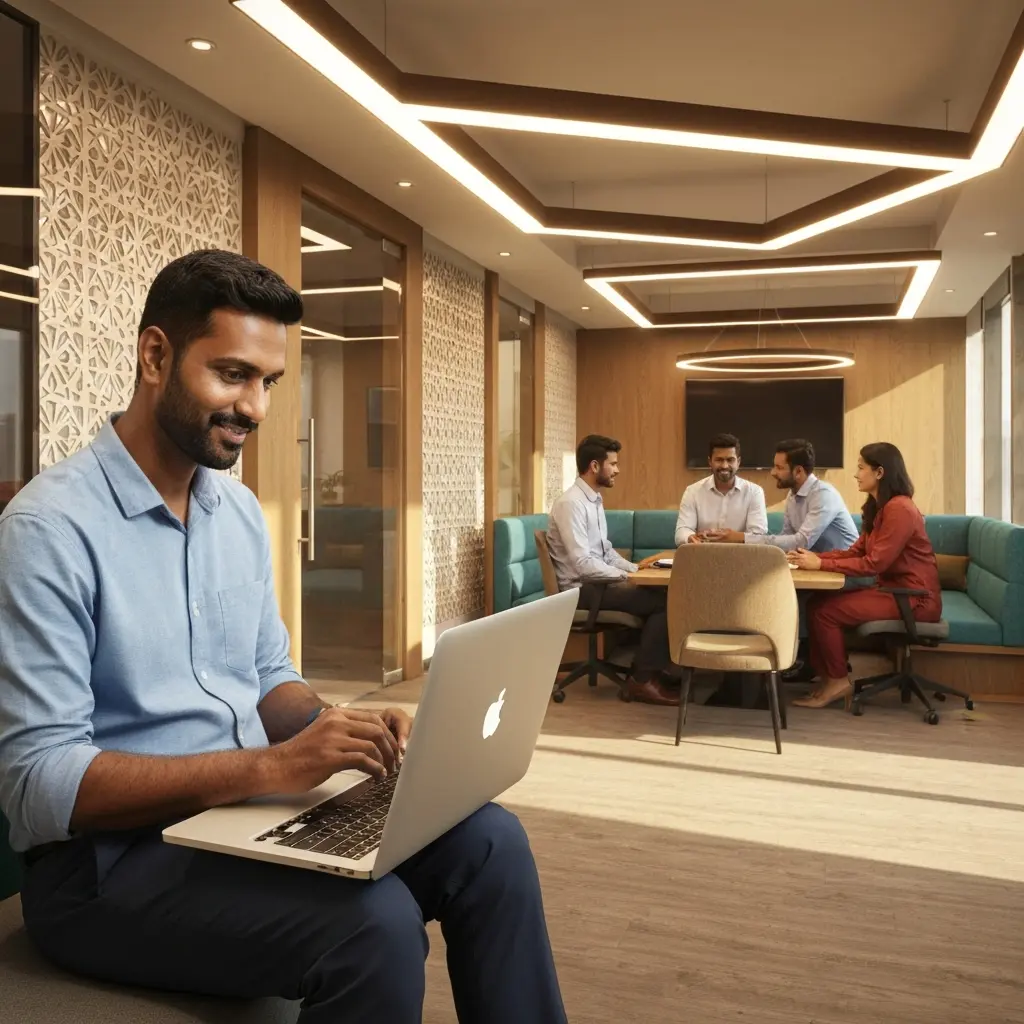
Occupancy data reveals that ‘Third Spaces’—informal lounges and cafes—now account for 40% of floor plans in top-performing offices. These zones are not cost centres; they are innovation catalysts where serendipitous connections happen, fostering a community that can lead to partnerships, client referrals, and cross-pollination of ideas essential for growth.
The 2026 Outlook for Indian Workspaces
In 2026, the Indian workspace market will see a clear stratification. Basic co-working will compete on price, while premium operators will compete on cognitive performance and neuro-inclusive design. Enterprise tenants, particularly in tech and knowledge sectors, will mandate these features in their flexible office RFPs. We will also see a rise in ‘neighbourhood hubs’ in Tier-1 and Tier-2 cities, as companies decentralise to tap into talent pools and reduce commute-linked attrition. Sustainability metrics will shift from energy efficiency alone to include material circularity and biophilic impact on occupant wellbeing.
Key Takeaways
- Audit Sensory Load: Move beyond ‘quiet zones.’ Provide a true spectrum of sensory environments to support your entire team’s neurological diversity.
- Prioritise Biophilic 2.0: Seek immersive natural elements (air-purifying plants, water) that measurably reduce stress, not just decorative greenery.
- Demand Modularity: Ensure your workspace partner can physically reconfigure layouts quickly to support your team’s changing size and project needs.
- Value Third Spaces: Allocate significant floor area to informal connection zones; they are where community and unexpected business opportunities thrive.
- Focus on Operational Wellness: Choose partners where circadian lighting, ergonomic feedback, and repair-first furniture are standards, not luxuries.
In conclusion, the workspace in 2026 is a dynamic tool for cognitive enhancement and business agility. For Indian entrepreneurs and corporate leaders, choosing a partner that embodies these neuro-inclusive office design principles is no longer an aesthetic preference but a strategic growth decision. It directly impacts your team’s output, health, and innovative capacity.
We invite you to experience this future of work. At Crizone Business Centre, our design philosophy is being shaped by these very 2026 trends, creating calmly efficient, neuro-adaptive environments designed to be your growth partner in Chennai’s evolving business landscape.
Continue your workspace search
Explore the most relevant Crizone pages next
If this article is part of your Chennai workspace research, these pages help you move from reading into comparing live plans, locations, and fit.
Explore coworking plans in Chennai
Compare day passes, dedicated desks, private offices, meeting rooms, and virtual office options from one commercial hub page.
Book a day pass in Chennai
Best fit if you need occasional workspace access, a short productive break from home, or a flexible desk for a single day.
Compare dedicated desk options
A stronger fit for regular monthly use when you want a fixed seat, better routine, and predictable workspace costs.