· Business Growth & Workspace · 7 min read
Regenerative Office Design: The 2026 Workspace for Indian Business Growth
In 2026, workspace design is a strategic growth lever. Learn how neuro-inclusive zoning and biophilic restoration in flex spaces directly impact talent retention and profitability for Indian SMEs.
TL;DR: By 2026, the smartest business investment is your team’s energy. A regeneratively designed workspace, using neuro-inclusive zoning and biophilic restoration, directly improves focus, reduces sick days, and attracts top talent. For Indian SMEs, this translates to tangible productivity gains and a powerful competitive edge.
For years, the Indian entrepreneur’s workspace choice was dictated by hard costs: rent per square foot on Mount Road, the security deposit, and the air conditioning bill. The question was purely financial. However, a more potent metric now dictates growth: human energy. The post-pandemic identity crisis of the office has resolved into a clear, singular purpose: to actively regenerate its occupants. This regenerative office design is no longer a luxury trend but a core business strategy, especially in dynamic markets like Chennai where talent retention and operational efficiency are paramount. The inflexible, sterile lease model fails to support this new mandate.
What is Regenerative Office Design?
Regenerative office design is a holistic methodology where the physical workspace is engineered not just to house workers, but to actively restore their cognitive and physical energy. It moves beyond basic functionality or sustainability to create environments that enhance well-being and performance through intentional design principles. This framework integrates neuro-inclusive zoning for diverse cognitive needs and biophilic restoration to connect occupants with natural systems, resulting in a space that fuels productivity rather than drains it.
How Does Neuro-Inclusive Zoning Boost Indian Team Productivity?
Indian businesses operate in a high-stimulus environment, from bustling city commutes to a packed festival calendar. The traditional open-plan office adds another layer of constant, unfiltered stimulation. Neuro-inclusive zoning recognises that up to 20% of any workforce is neurodivergent (a figure consistent with global studies) and that all employees benefit from having control over their sensory environment. The 2026 standard is a ‘Sensory-Mapped’ floorplan.
This means clearly designated ‘High-Stimulus’ zones for collaboration—vibrant, acoustically lively areas with writable walls. Alongside them are ‘Low-Stimulus’ sanctuaries for deep work: spaces with soft, muted colours, advanced sound masking, and minimal visual clutter. For an SME founder in Chennai, this isn’t just about comfort; it’s about output. It allows your finance team to reconcile accounts without OMR traffic noise distraction, while your sales team brainstorms freely nearby.
Crizone Pro Tip: Audit your team’s workflow. Map ‘focus’ tasks versus ‘collaboration’ tasks across a typical week. Your ideal workspace should have dedicated, bookable areas for each mode, preventing costly context-switching.
The 3 C’s Framework—Clarity, Choice, and Calm—guides this. Clarity in intuitive wayfinding reduces cognitive load. Choice is offered through adjustable furniture, lighting controls, and movable ‘Modular Hacking’ elements like acoustic curtains. Calm is engineered through sensory reset rooms—a quiet, dimly lit space for a 10-minute mental break, far more effective than scrolling social media at a desk.
[Image of Neuro-Inclusive Zoning Diagram]
Caption: A sensory map of a workspace showing clear pathways (Clarity), distinct High & Low Stimulus zones (Choice), and designated reset areas (Calm).
Is Sustainable Furniture Just an Ethical Choice, or a Financial One?
The global shift to certified, low-impact materials like bamboo and recycled composites, now an ₹4.4 lakh crore market, is driven by more than ethics. For an Indian business, the financial calculus of furniture has changed. The old model involved a large capital expenditure (CapEx) for fixed, often imported, furniture that depreciated and became a liability.
| Cost Factor | Traditional Office (Chennai) | 2026 Regenerative Flex Model |
|---|---|---|
| Furniture Procurement | High upfront CapEx (₹5-10 Lakhs for SME fit-out) | Included in monthly membership; OpEx model. |
| Material & Maintenance | Prone to wear; replacement is a new purchase & waste. | Operator manages ‘Circular Economy’ refurbishment using ‘Material Passports’. |
| Design Flexibility | Fixed layout; costly to change as team grows/shrinks. | ‘Modular Hacking’ allows team reconfiguration in 15 mins at no extra cost. |
| Well-being ROI | Unmeasured, often negative impact on sick days & focus. | Linked to 15-20% reduction in sick days and measurable focus gains. |
The 2026 model is operational expenditure (OpEx) and circular. Premium flex operators procure furniture with ‘Material Passports’ that track every component, enabling easy refurbishment and reuse. This eliminates your disposal headache and aligns with GST-era compliance needs for asset tracking. Furthermore, the move to ‘Organic Shapes’—curved seating and irregular tables—isn’t merely aesthetic. Studies indicate such forms reduce cortisol, the stress hormone, directly impacting the creative flow essential for problem-solving in competitive markets.
Can Biophilic Design Really Impact Your Bottom Line?
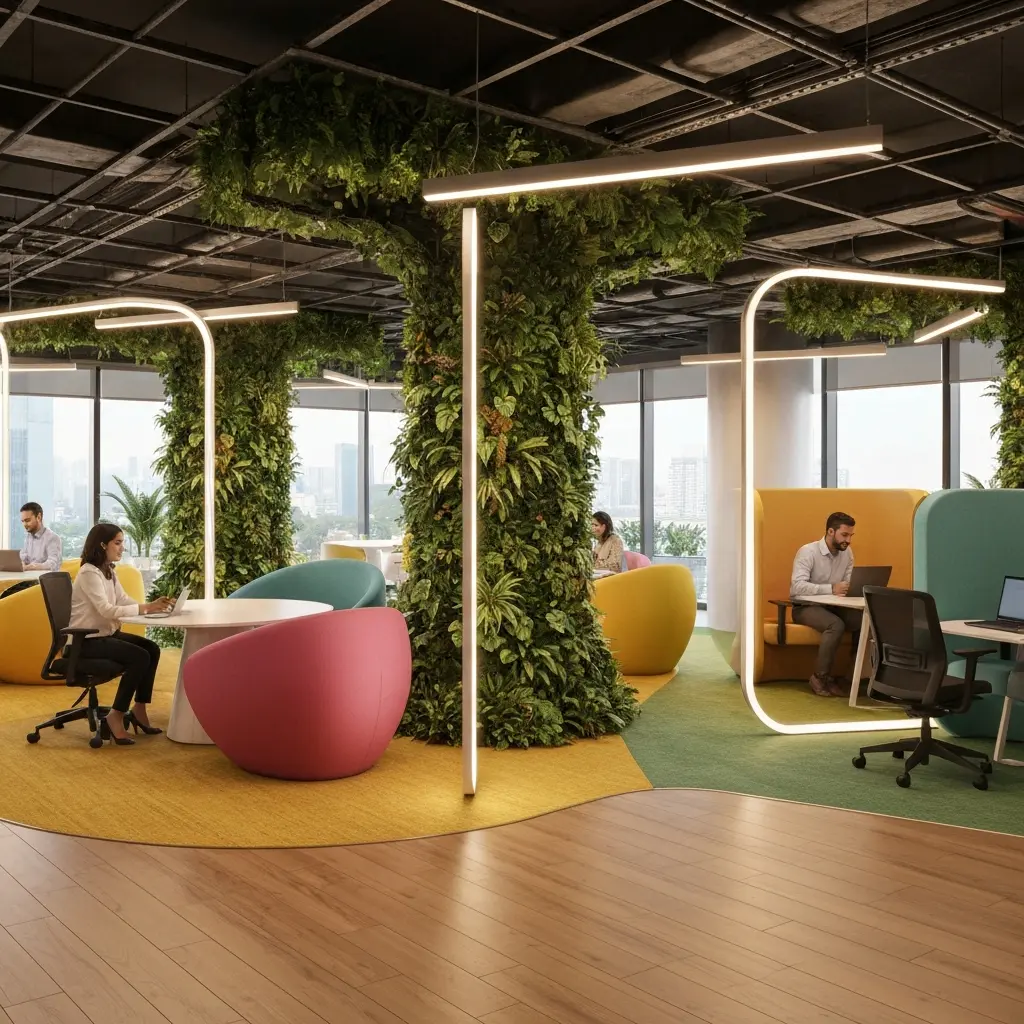
Biophilic integration in 2026 has evolved from a few potted plants to integrated ‘Living Systems.’ Think vertical gardens that act as natural air-purifiers, moss walls that regulate humidity—a boon in Chennai’s climate—and terraces with native planting that provide genuine outdoor access. The data is compelling: such environments can reduce employee sick days by nearly 20% and boost overall well-being by 15%.
For a branch manager, this translates directly to lower absenteeism and higher, more consistent output. For a founder, it becomes a powerful talent attraction and retention tool. In leading global markets, biophilic spaces command a 5-10% rental premium because they deliver superior human performance. This is complemented by ‘Regenerative Acoustics’ using materials like biodegradable mycelium-based panels, which manage sound while contributing to a Net-Zero carbon goal, a growing priority for corporate clients.
Manager Insight: When evaluating a workspace, measure the ‘access to nature’ quotient. Does it have genuine daylight penetration, views of greenery, and operable windows for fresh air? These are not amenities; they are productivity tools.
Another critical ergonomic feature is Circadian Lighting Synchronization. Systems that automatically adjust colour temperature from cool, energising light in the morning to warm, relaxing tones in the late afternoon combat the digital eye strain affecting 90% of professionals. This supports natural sleep cycles, meaning your team rests better and arrives more refreshed—a simple but profound upgrade over static, harsh fluorescent lighting common in traditional offices.
The 2026 Outlook for Indian Workspaces
As we move through 2025 and into 2026, the Indian flexible workspace market will bifurcate. Basic, utilitarian co-working will compete on price, while premium brands will compete on human-centric design and performance outcomes. We will see the principles of regenerative design—neuro-inclusion, biophilic restoration, and circular material use—become the baseline expectation for companies seeking to attract and enable top talent. In cities like Chennai, Bangalore, and Mumbai, access to such scientifically-designed environments will be a key differentiator in the war for talent, directly influencing where skilled professionals choose to work and grow.
Key Takeaways
- Design for Energy, Not Just Space: Choose a workspace that actively restores your team’s mental and physical resources to directly boost productivity and innovation.
- Demand Sensory Choice: Ensure your workspace offers distinct zones for collaboration and deep focus, catering to the neurodiversity of your team and the different modes of work.
- Evaluate the Total Cost of Well-being: Look beyond rent. Calculate the hidden costs of sick days, turnover, and low engagement that a sterile office incubates versus the ROI of a regenerative one.
- Seek Living Systems, Not Just Decor: Prioritise spaces with authentic biophilic integration (natural light, air-purifying plants, outdoor access) which are proven to enhance health and cognitive function.
- Future-Proof with Flexibility: Opt for environments with modular, adaptable furniture and circular economy principles to avoid capital lock-in and easily scale your team up or down.
Conclusion
The evolution from a cost-centric office lease to an energy-centric workspace partner marks a fundamental shift in how Indian businesses fuel growth. The 2026 regenerative workspace is a strategic asset, engineered to enhance the well-being and output of your most valuable investment: your people. It turns the physical environment from a static overhead into a dynamic catalyst for focus, creativity, and resilience. For businesses in Chennai looking to navigate this shift, the path forward involves partnering with a space designed with these very principles at its core. At Crizone Business Centre, we are curating such regenerative environments to serve as the growth partner for your next chapter.
Continue your workspace search
Explore the most relevant Crizone pages next
If this article is part of your Chennai workspace research, these pages help you move from reading into comparing live plans, locations, and fit.
Explore coworking plans in Chennai
Compare day passes, dedicated desks, private offices, meeting rooms, and virtual office options from one commercial hub page.
Book a day pass in Chennai
Best fit if you need occasional workspace access, a short productive break from home, or a flexible desk for a single day.
Compare dedicated desk options
A stronger fit for regular monthly use when you want a fixed seat, better routine, and predictable workspace costs.