· Business Growth & Workspace · 7 min read
Staffless Coworking Cuts 35% Opex by 2026
Autonomous 'ghost' coworking models are achieving 35% opex reductions using AI and IoT. This guide explains how it helps Indian SMEs grow.
TL;DR: The flexible workspace model is evolving. In 2026, AI-driven, staffless coworking centres offer a 35% reduction in operational costs, with keyless entry, smart energy management, and automated systems. This model allows Indian businesses to reinvest directly into growth while offering employees a seamless, tech-enabled workplace, free from the inefficiencies of a traditional office lease.
Introduction: The Productivity and Profitability Pinch
For an Indian entrepreneur or SME founder, the classic office lease often represents a significant financial drain and an operational headache. From navigating Chennai’s infamous OMR traffic to managing office overheads like rent, utilities, and administrative staff, the traditional model diverts critical resources away from core business growth. The demand for flexible, predictable, and agile workspaces is no longer a trend but a strategic necessity. In this environment, the most significant evolution is the rise of the staffless coworking model. By 2026, the industry’s focus has decisively shifted towards automation, where technology—not just hospitality—drives profitability and unlocks a leaner path to business scaling for Indian companies.
What is Staffless Coworking?
An autonomous or ‘ghost’ coworking space is a premium, fully tech-enabled workspace operated without a permanent on-site management team. It leverages integrated AI and IoT systems to handle access control, member onboarding, billing, energy management, and maintenance, creating a seamless user experience. This model is distinct from a conventional coworking centre, where operational costs are tied to human-led front desk services and community management. Instead, it prioritises operational efficiency, cost predictability, and 24/7 accessibility, effectively becoming a high-margin, low-touch ‘third workplace’.
How Does Automation Slash Operational Costs?
The financial advantage of the autonomous model is stark. In a traditional office or a high-touch flexible space, 50-60% of operational expenditure can be tied to staff salaries, management, and reactive facility upkeep. By Q1 2026, AI-powered platforms have matured to automate these core functions, delivering documented Opex reductions of up to 35%. The savings stem from eliminating the need for 24/7 front-desk personnel, automating administrative tasks like invoicing and GST-compliant receipts, and using smart systems for predictive maintenance. This directly translates to lower membership fees or, for business owners, the ability to reinvest those significant savings into talent, marketing, or product development.
Crizone Business Centre Pro Tip: For an SME, predictable monthly costs are as valuable as low costs. An autonomous model converts variable expenses (like sudden AC repairs or overtime for admin staff) into fixed, transparent monthly fees, allowing for more accurate financial forecasting in a volatile market.
| Traditional Office/Coworking Cost Component | Autonomous Staffless Model (2026) |
|---|---|
| Front Desk & Community Manager Salary | AI-driven CRM & Virtual Concierge (Cost: ~0) |
| Reactive Maintenance & Downtime | Predictive AI Monitoring (Reduces downtime by 30-50%) |
| Manual Billing & Admin (TDS/GST) | Fully Automated Billing Platform |
| Energy Waste from Unoccupied Areas | IoT Sensors for Smart Lighting/AC (Saves 20-30%) |
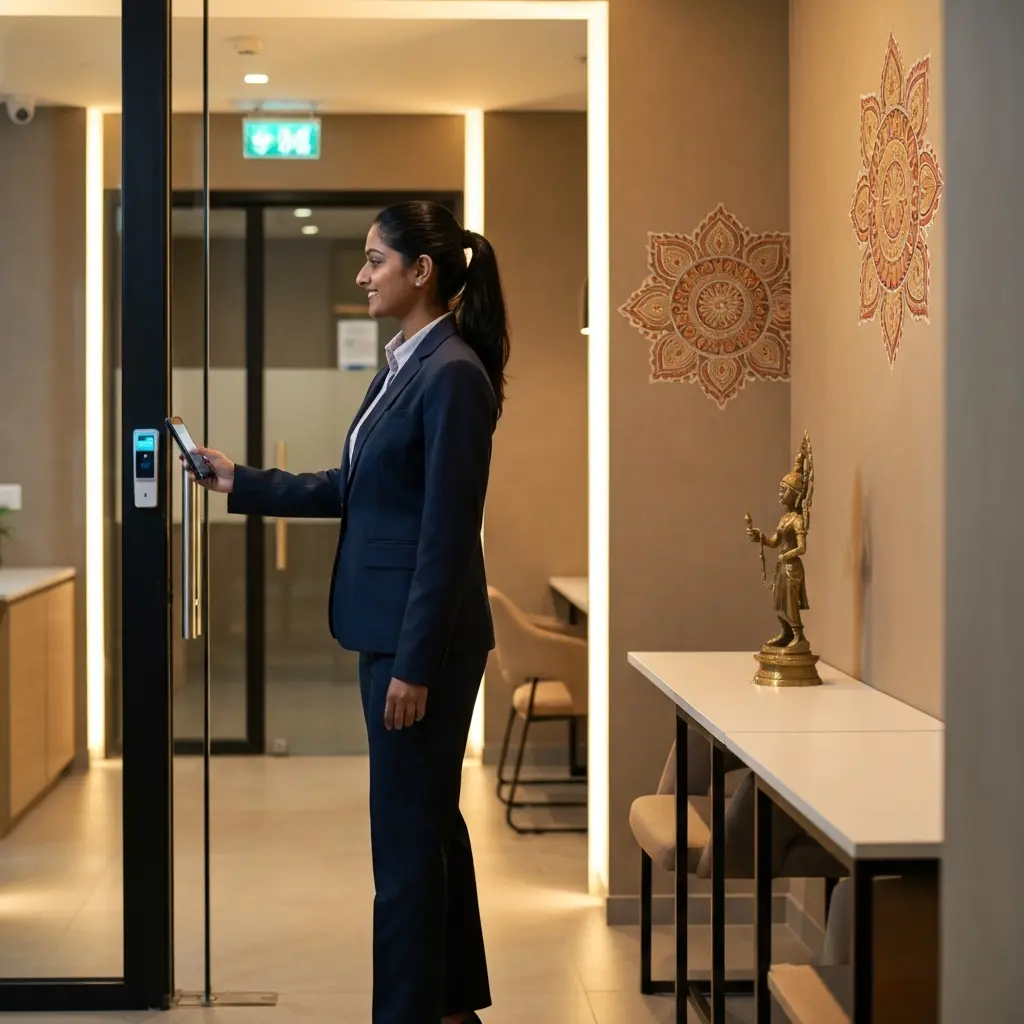
| Key/Fob Management & Security | Multi-Modal Biometric Access (e.g., 0.17-sec palm scan) |
[Image of a comparative bar chart showing Traditional Office vs. Autonomous Workspace operational costs, with percentages for Staff, Energy, Maintenance, and Admin, labelled in INR Lakhs saved per annum.]
Is ‘Tech-Only’ the Right Environment for Your Team?
A common concern for leaders is whether a staffless model sacrifices the ‘human element’ crucial for morale. The 2026 answer is nuanced. For teams that value absolute focus, minimal interruption, and the freedom to structure their day without front-desk formalities, it is ideal. The technology itself enhances productivity: imagine walking into a perfectly lit, climate-controlled cabin in Chennai’s humid weather, booked via an app, unlocked by your palm in 0.17 seconds, with everything working seamlessly. The model suits digitally-native startups, remote corporate teams, and consultants who prioritise efficiency over curated networking events. It complements, rather than replaces, the high-touch hub; a business might use an autonomous centre for daily deep work and a serviced office for monthly client meetings.
Insight for Branch Managers: An autonomous satellite office in a suburban Chennai location like Ambattur or Navalur can drastically cut commute times for local team members, boosting daily productivity by over an hour while providing a corporate-grade professional address without the overhead of a full-service branch.
Building Smarter: The Role of IoT and Data
The backbone of this model is a network of smart sensors and data analytics. Desk occupancy sensors, now a ₹3,700 Crore global market, provide heat-mapping data to eliminate underutilised ‘dead zones,’ allowing operators to optimise space design. More critically for the Indian context, IoT systems manage energy consumption intelligently. Lights and AC units in meeting rooms or private cabins activate only upon registered occupancy, slashing utility bills by 20-30%—a major cost in India’s commercial real estate. Furthermore, these tamper-proof systems provide real-time safety and occupancy audits, which, as per 2026 data, can secure insurance premium discounts of up to 15% by demonstrably lowering risk.
[Image of a smartphone app interface showing real-time occupancy heatmaps of a coworking floor, with zones colour-coded from red (occupied) to blue (vacant), and controls for lighting and AC in a private cabin.]
From Cost Centre to Profit Driver: The Accelerated Path to Profitability
The ultimate business impact is on the bottom line. For workspace operators, the model’s efficiency is revolutionary: 75% of staffless spaces reach profitability within 24 months, compared to the 36-month average for traditional models. For the member company, this efficiency is passed on as value. The savings enable operators to invest in better infrastructure, more reliable high-speed internet, and premium furnishings. For an Indian SME, using such a space transforms real estate from a capital-intensive liability into a scalable, variable-cost utility. You pay only for the space and time you use, scaling up or down around project cycles or festive season downtimes without penalty, turning a fixed cost into a strategic, flexible tool for growth.
The 2026 Outlook for India’s Workspace Market
By the end of 2026, we predict a clear bifurcation in India’s flexible workspace market. High-touch, hospitality-driven centres will thrive in prime business districts for client-facing functions. Concurrently, the growth of ‘15-minute city’ workforce hubs in suburban areas like Chennai’s Perungudi or Mumbai’s Andheri East will be overwhelmingly driven by autonomous, staffless models. Their profitability in lower-rent zones makes premium workspace accessible outside traditional CBDs. Expect a surge in partnerships between real estate owners and tech platforms to launch such spaces, with Indian operators leveraging homegrown AI and IoT solutions to manage costs. The defining metric will shift from mere occupancy to ‘RevPAM’ (Revenue Per Available Member), maximised by precision space management.
Key Takeaways for Business Leaders
- Audit Your Operational Expenditure: Analyse what portion of your opex is tied to physical office management and administration. The potential 35% saving is a compelling case for change.
- Prioritise Access & Efficiency: For teams focused on delivery, seamless 24/7 access and a distraction-free environment can yield greater productivity gains than a bustling social hub.
- Leverage Data for Decisions: Choose a workspace provider that offers data on space utilisation. This insight can help you right-size your commitment and avoid paying for unused square footage.
- Factor in Hidden Savings: Consider the compound value of reduced employee commute time, lower insurance premiums through smart safety systems, and the elimination of capex on office fit-outs.
- Future-Proof Your Flexibility: Adopt a workspace solution built on an automated platform. It ensures scalability and cost control, allowing you to pivot quickly in response to market opportunities.
Conclusion
The rise of the staffless, autonomous workspace is not about removing the human touch from business; it’s about removing friction and unnecessary cost from the work environment. For the ambitious Indian business, it represents a strategic tool to enhance operational efficiency, protect margins, and liberate capital for reinvestment. It answers the core challenges of urban commuting, cost inflation, and the need for agile scaling. This is the new benchmark for a growth-oriented workplace: intelligently automated, reliably professional, and fundamentally efficient.
Explore how a Crizone Business Centre membership in Chennai provides this precise, tech-forward environment. Our integrated systems manage access, amenities, and ambiance, allowing you and your team to focus solely on what drives your business forward. Let your workspace be a catalyst for growth, not a constraint.
Continue your workspace search
Explore the most relevant Crizone pages next
If this article is part of your Chennai workspace research, these pages help you move from reading into comparing live plans, locations, and fit.
Explore coworking plans in Chennai
Compare day passes, dedicated desks, private offices, meeting rooms, and virtual office options from one commercial hub page.
Book a day pass in Chennai
Best fit if you need occasional workspace access, a short productive break from home, or a flexible desk for a single day.
Compare dedicated desk options
A stronger fit for regular monthly use when you want a fixed seat, better routine, and predictable workspace costs.