· Business Growth & Workspace · 7 min read
Organic Modular 2026 Office Design: The New Standard for Growth
This guide explores Modular, Non-Rectilinear Design, a key 2026 workplace trend that enhances productivity, cuts costs, and drives business growth. Essential reading for Indian founders.
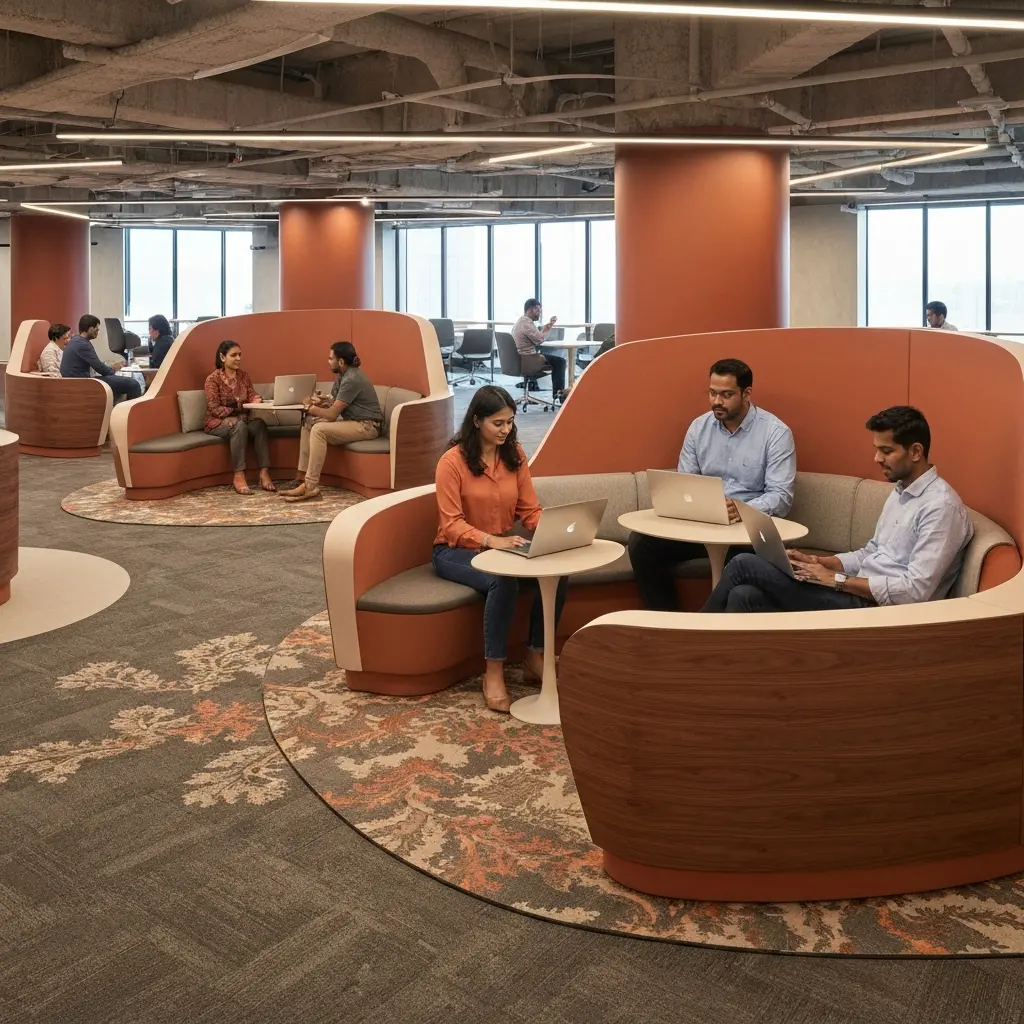
TL;DR: The 2026 workplace is defined by Organic Modularism—a fluid, non-rectilinear design philosophy. For Indian businesses, it directly tackles high costs and low team productivity by boosting creativity 15% and cutting real estate waste by 20-30%. This is the new growth-enabling standard.
Introduction: Moving Beyond the Straight and Narrow
The traditional long-term office lease in Chennai is a high-stakes gamble for a growing business. Between fluctuating team sizes, rising OMR corridor rents, and the rigidity of fixed layouts, you either pay for wasted space or outgrow your shell too soon. This inflexibility hampers scaling, a critical pain point for Indian SMEs and startups. Simultaneously, the demand for spaces that attract and retain top talent has never been higher. Modern professionals seek environments that support their well-being and workflow, not just a desk under harsh lighting. The answer lies in a fundamental redesign of the workspace itself—moving from static, rectilinear boxes to dynamic, human-centric ecosystems. This evolution is captured in the 2026 standard of organic office design, a strategic shift from aesthetics to performance-driven environments that directly fuel business growth.
What is Organic Office Design?
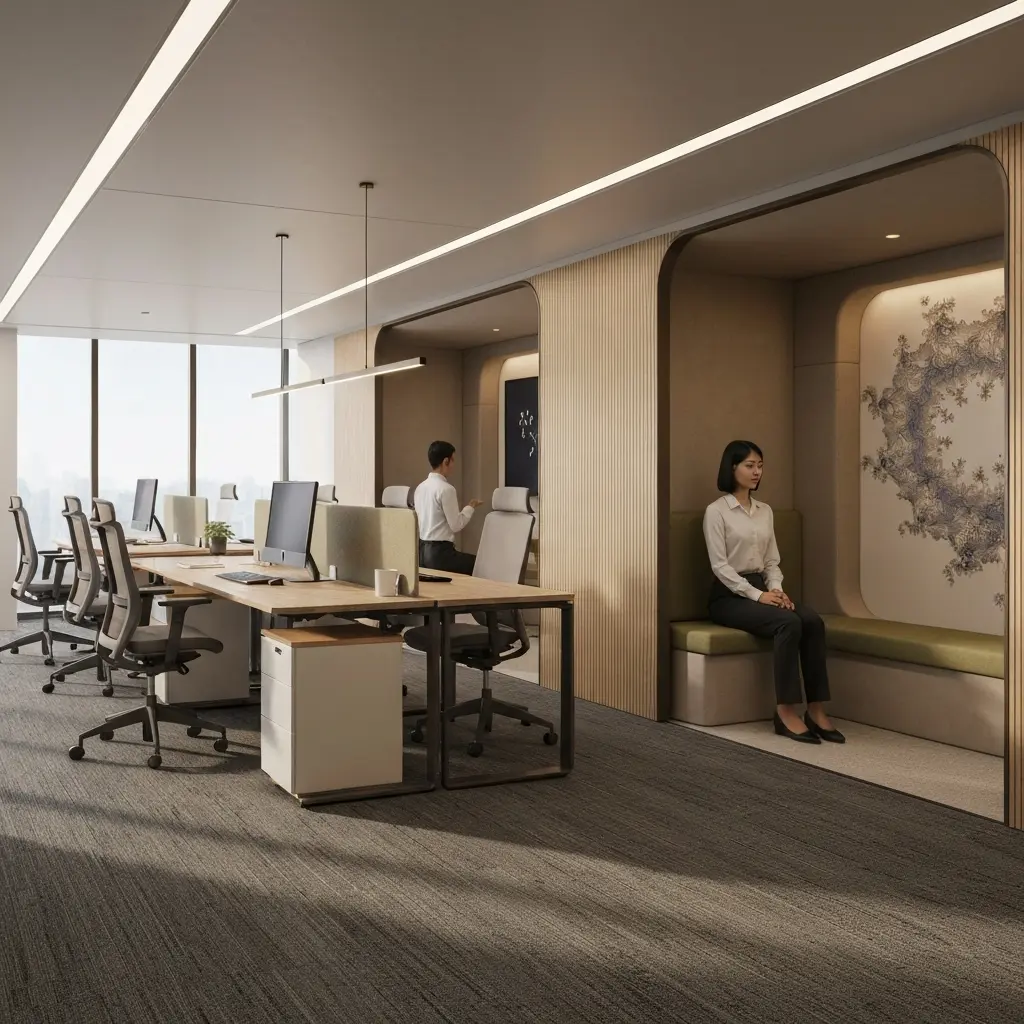
Organic office design, also termed Bio-Modularism, is a high-performance workspace philosophy prioritising fluid spatial planning, biophilic elements, and extreme modularity. It replaces traditional straight lines and sharp angles with curved, soft geometries and utilises furniture systems that can be quickly reconfigured. The core purpose is to create environments that reduce cognitive stress, enhance creativity, and adapt seamlessly to daily business needs, thereby solving the chronic under-utilisation of fixed office space.
Why Fluid, Adaptive Spaces Are a Business Imperative, Not a Trend
Consider the typical workday for an Indian founder: deep work on financial models, a client presentation, a team brainstorming session, and a one-on-one mentoring chat. A traditional four-walled office forces all these activities into the same rigid environment, which science shows increases stress. Fluid spatial planning—using curved seating areas, oval tables, and non-linear pathways—creates intuitive zones for different modes of work. This isn’t just about looking modern; the 2026 Interior Fusion report confirms such layouts actively reduce employee stress by eliminating the subconscious tension sharp angles can create.
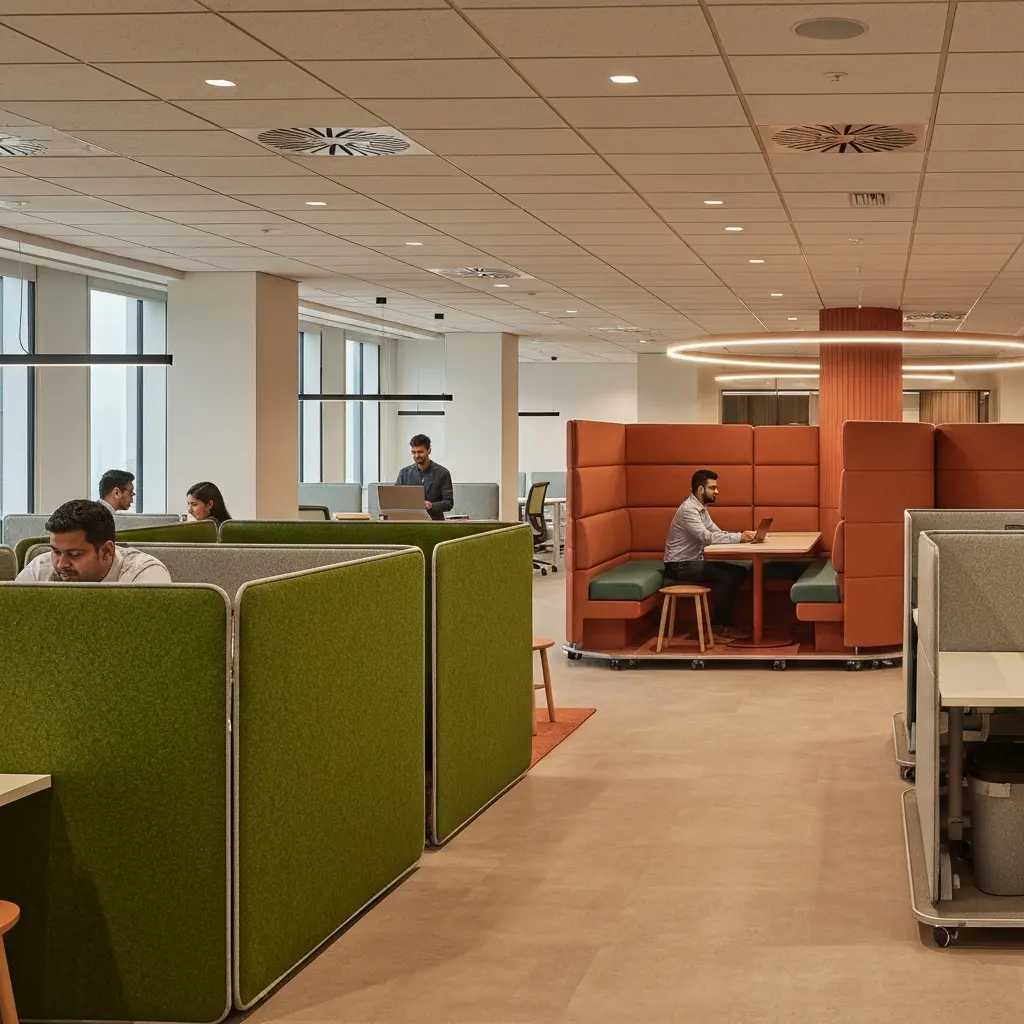
For the business, this adaptability solves a critical financial drain. Global data shows average office utilisation is just 54%, meaning nearly half your leased space is dead capital. In an Indian context, where every square foot in a tech park like Tidel Park or on the IT corridor carries a premium, this waste is unsustainable. A workspace built on modular coworking furniture allows you to transform a quiet solo pod into a 6-person huddle room in minutes, ensuring your physical footprint—and monthly outgo—directly aligns with actual use.
Crizone Pro Tip: Map your team’s weekly activities. If ‘collaboration’, ‘focus’, and ‘connection’ happen in the same static room, you’re likely losing productivity. Prioritise spaces that can morph to match the task at hand.
The Tangible ROI: From Well-Being to the Bottom Line
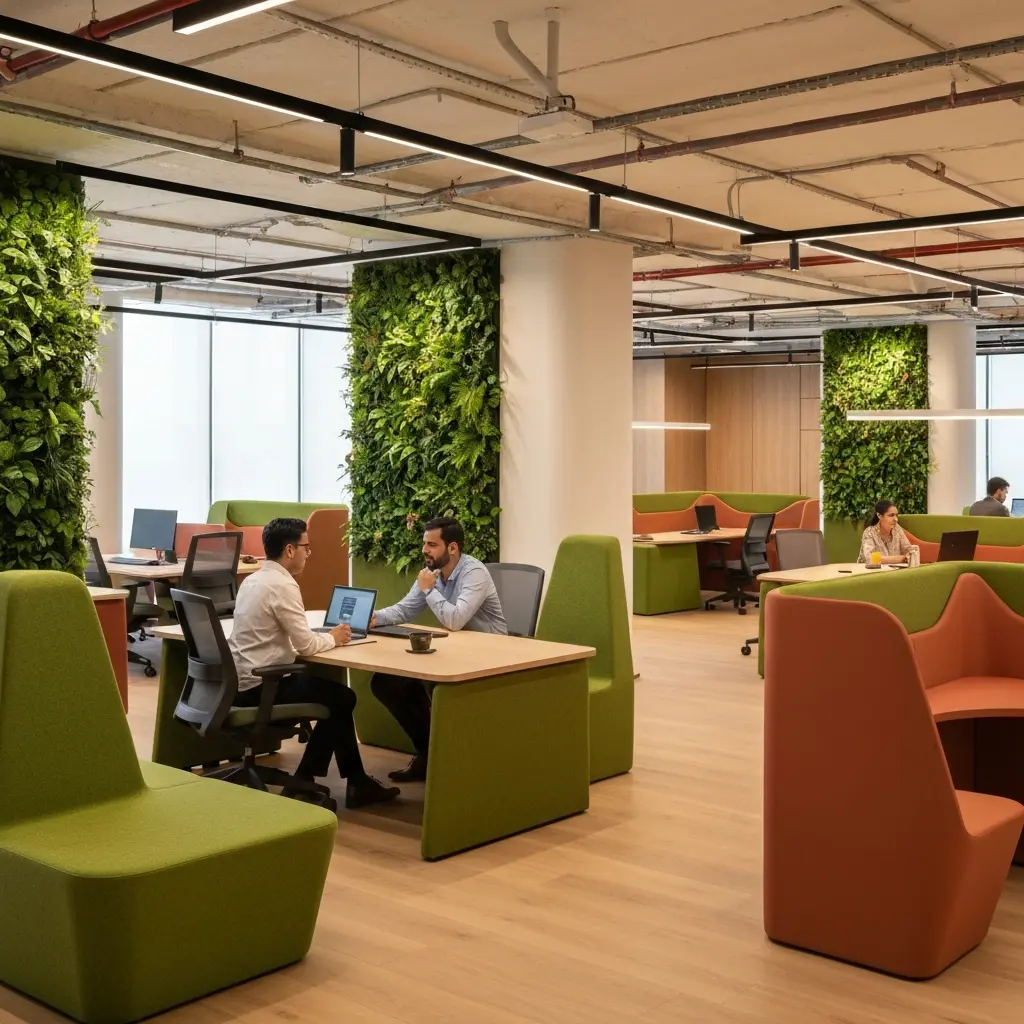
How does a curved wall or a partition made from rice husks translate to profit? The connection is direct and data-backed. Research from the DLR Group shows integrating authentic biophilic elements—think natural light, live plants, and furniture with natural fractal patterns—boosts creativity by 15% and overall productivity by 6% in collaborative settings. In a market where innovation speed defines winners, this is a potent competitive edge.
The financial savings are equally compelling. A Capital Choice 2026 study found operators using modular, non-fixed systems report a 20-30% reduction in real estate costs by eliminating dead space. For an Indian SME, this could mean turning fixed costs into variable, growth-friendly investments.
| Cost Factor | Traditional Chennai Office Lease | Organic Modular Solution (e.g., Crizone) |
|---|---|---|
| Monthly Commitment | Fixed, high deposit. 11-month minimum. | Flexible membership. No large deposit. |
| Space Utilisation | ~50-60%. You pay for unused ‘dead’ space. | ~85-95%. Pay only for the space & time used. |
| Fit-out & Furniture | Capital expenditure (CapEx) of ₹5-10 Lakhs+. High cost to reconfigure. | Operational expense (OpEx). Included & reconfigurable at no extra cost. |
| Maintenance (AC, Cleaning) | Direct cost and management headache. | Fully managed and included in the membership. |
This shift to ‘Space-as-a-Service’ moves large capital expenditures (CapEx) for fit-outs and furniture off your books, turning them into predictable operational expenses (OpEx). This frees crucial capital—often in the range of several lakhs—for hiring, marketing, or product development instead of stationary walls and desks.
Built for the Future: Sustainability, Longevity, and Legacy
The 2026 standard extends beyond daily efficiency to long-term responsibility. Design for Disassembly (DfD) is now a mandatory metric, meaning every modular component is designed to be reused, refurbished, or recycled at end-of-life. This aligns with global ESG goals and the growing preference of Indian talent for environmentally conscious employers.
Materials are also undergoing a revolution. The use of agricultural waste composites—like panels from rice husks and sugarcane bagasse—for partitioning is becoming standard, as per the Gebesa 2026 report. This not only reduces carbon footprint but also supports circular economy principles, a strong brand value in today’s market.
Perhaps most innovatively, the concept of ‘Soft Retirement Nodes’ acknowledges India’s rich intergenerational knowledge. These are intentionally designed, low-stimulation zones within a vibrant workspace that facilitate mentorship between experienced professionals and younger teams. For a family business or an SME valuing legacy knowledge, this design feature can be invaluable for seamless transition and training.
Manager Insight: Your workspace is a physical statement of your company’s values. A sustainable, adaptable, and human-centric environment attracts talent who share those values and are invested in long-term growth.
Is Your Workspace Designed for 2026 Growth?
To assess if your current setup is holding you back, consider these questions: Can your meeting space be repurposed for a workshop in under 15 minutes? Does the design help your team recover from the cognitive load of Chennai traffic? Are you paying for a boardroom that sits empty 90% of the time? If the answers point to rigidity and waste, your operational model is outdated.
The integration of Intelligent Biomechanics in ergonomics exemplifies the next frontier. Organic-form chairs with posture sensors provide AI-assisted feedback, adjusting to support deep-work sessions. This proactive approach to employee health reduces fatigue and absenteeism, protecting your most valuable asset—your team’s capacity.
[Image of a side-by-side diagram: A rigid office floor plan vs. a fluid, modular plan] A diagram contrasting a traditional rectilinear office layout with large areas of ‘dead space’ versus an organically planned space with fluid zones that adapt from individual focus pods to team collaboration areas.
The 2026 Outlook for India’s Workspace Market
In 2026, the Indian workspace market will decisively split. On one side will be static, cost-centre offices struggling with occupancy and talent attraction. On the other will be high-performance, asset-light growth centres. We predict a surge in demand for workspaces that offer biophilic integration and extreme modularity as non-negotiable features, not luxury add-ons. Chennai, with its expanding corporate corridors and booming startup ecosystem, will be at the forefront of this adoption. Operators who fail to move beyond ‘decorated boxes’ to truly designed, performance-driven environments will face significant obsolescence.
Key Takeaways for Indian Business Leaders
- Adopt Fluid Layouts: Replace rigid desks and straight lines with curved, adaptable zones to lower team stress and intuitively support different work modes.
- Treat Space as a Service: Shift from capital-heavy leases to flexible memberships that convert real estate from a fixed cost to a variable, scalable resource.
- Prioritise Biophilic Authenticity: Integrate real natural elements and fractal patterns. The data is clear: it boosts creativity and productivity, offering a direct return on investment.
- Demand Sustainable Modularity: Choose partners who use Design for Disassembly (DfD) and sustainable materials like agricultural waste composites for future-proofing and brand alignment.
- Plan for Knowledge Continuity: Seek environments with designed spaces for intergenerational mentoring to preserve and transfer critical legacy knowledge within your organisation.
Conclusion
Organic office design is far more than an interior design trend for 2026. It is a strategic operational framework that directly addresses the core challenges of the modern Indian business: escalating costs, talent retention, and the need for agile scalability. By embracing environments that are fluid, sustainable, and human-centric, you invest in a infrastructure that actively fosters well-being, collaboration, and innovation. It transforms your workspace from a passive overhead into a dynamic engine for growth.
We have designed the Crizone Business Centre in Chennai with precisely these 2026 principles at its core. Discover how our organically modular, high-performance environments can become your strategic growth partner. Let’s discuss how a space that adapts to you can help your business scale with calm efficiency.
Continue your workspace search
Explore the most relevant Crizone pages next
If this article is part of your Chennai workspace research, these pages help you move from reading into comparing live plans, locations, and fit.
Explore coworking plans in Chennai
Compare day passes, dedicated desks, private offices, meeting rooms, and virtual office options from one commercial hub page.
Book a day pass in Chennai
Best fit if you need occasional workspace access, a short productive break from home, or a flexible desk for a single day.
Compare dedicated desk options
A stronger fit for regular monthly use when you want a fixed seat, better routine, and predictable workspace costs.